Wednesday, November 24, 2010

Ask Doctor Wally: winter riding

Here's the December 'Ask Wally' column from the Red Dirt Pedaler's newsletter. The Lanterne Rouge piece is over on the Examiner.

Dear Doctor Wally... For the first time, I want to keep riding through the winter this year. What do I need?........... Resolute in Red Fork

First, I admire your determination. Riding through Oklahoma winters can be both challenging and a ton of fun. Here are some brief tips:

If you don't already have fenders on your bike, fit them now. They reduce the grunge factor when riding on wet roads, so you stay cleaner, drier, and perhaps most importantly, warmer than you'd be without them. It's not uncommon for winter riders to have an old beater bike specifically for bad weather. Even if you don't normally ride at night, have lights and reflectors on your bike and be certain that they work.

Get some good quality cycling tights. They come in different weights, some with bib tops, and some with double fronts. They're one winter riding essential. Don't wear sweatpants, long underwear under your shorts, or that big puffy down parka. The first two scream 'dork' and can put you in danger of hypothermia if they get wet. The latter will turn into a wearable sauna. You'll sweat like crazy, then freeze as it evaporates.

Wear multiple thin layers so you can regulate your temperature, and have a bike bag or messenger bag to carry items you have to shed. Keep a balaclava, gloves, and a scarf or neck gator handy. They make a huge difference in comfort.

But most important of all - enjoy those crisp, clear mornings!

Dr. Wally

Next month: CDC finds link between classic French bicycles and dementia in bike collectors.

Labels: , ,

Friday, October 17, 2008

Winter Cycling Attire

Image from JB/John on Flickr

Last month we covered how to make two essential tools for any eco-conscious cyclist, the obsidian knife and the stone ax. This month we'll discuss how to use them.

First, however, there's the issue of appropriate clothing for the season. With fall weather causing a drop in temperatures and an increase in precipitation, it's important that the well-prepared cyclist start thinking about winter attire.

Please don't make the common mistake of mud daubing. It lends itself well to the neolithic surrealism style that's a current Euro-fad, but it isn't a practical form of clothing during the winter months. Sure, there are some fashionistas who will not change with the weather, but even they realize that mud provides little insulation from cold and cannot stand up to rain. In summer, of course, it's excellent protection against sunburn and insects, but cold, wet weather reveals mud's limitations. Still, it's not unusual to see a woman stylishly covered in designer mud - with the requisite high-fashion footwear, of course - in some of those cycling photos from Copenhagen. Most of us prefer to be more comfortable and not suffer for the sake of fashion, so we make other choices.

Now, I'm assuming that anyone reading this is committed to using natural materials whenever possible, and will eschew all those synthetics flooding the market. Even those two natural favorites - cotton and wool - are tainted by their association with global agri-business, so eco-conscious bicyclists should pass them by as well.

First on almost everyone's list are dry leaves. Although they're not warm when wet, they contain the small dietary bonus of insects and ticks. Ticks are arachnids rather than insects, though they all taste pretty much the same, almost like crunchy, still wriggling chicken. While autumn leaves are certainly colorful, the colors don't last long. Autumn leaves dry out rapidly and have to be reapplied frequently. Dry leaves, on the other hand, are both plentiful and cheap, making them a popular choice with many fair-weather cyclists.

Moss is less popular than dry leaves mainly because it's more time-consuming to gather. But its properties out-weigh the additional time, making it a favorite among thoughtful cyclists interested in long-term use. In fact, some older cyclists may discover they already have a plentiful supply on their north sides. Moss dries rapidly. It's dense mat is like a thatched roof, shedding water much better than dried leaves. And unlike leaves, it's more durable.

Bark is an excellent choice for wind and rain protection, but it doesn't provide insulation. Also, bark is not very pliable so it can be uncomfortable. However, when bark is used as an outer layer with an insulating layer of dried moss underneath, the combination offers the best of both worlds, providing protection from wind, rain, and cold down to surprisingly low temperatures.

Controversy swirls around application methods. How are these materials best applied to the human body? Common methods include: staple guns, hot glue, or even sheet metal screws. One recommended accessory is a stick to clench between the teeth. It helps to muffle screams so the neighbors don't call the police complaining about out-of-season human sacrifices again. It's best to have someone help with the application as they'll have a more steady hand and can apply your leaves, bark, or moss symmetrically or in intricate patterns. An exciting new trend is developing that emphasizes a more random and natural-looking 'just rolled in the leaves' approach.

Regardless of the application method, the resulting scars will give you a stunning new look for the spring fertility rites!

A serviceable winter helmet can be carved from the bole of a tree. Turtle shells are another popular choice. This is where your obsidian knife and stone ax come in handy. You can make straps from vines and creepers. Moss provides padding and insulation. Ventilation is unnecessary as this is a cold weather item.

Animal fur is another exciting outerwear possibility. The hollow hair shafts found on deer, caribou, and polar bears offer superb protection, though killing a polar bear while armed with only an obsidian knife and a stone ax is somewhat problematic. Hunting polar bears is fairly easy, however, as their position atop the food chain insures that they'll come straight toward you when they're hungry. For some, this makes deer and caribou a more attractive resource as they're far less likely to kill and eat a hunter. Please don't make the neophyte's mistake of utilizing rabbit fur. Though they're plentiful and easy to trap, rabbit fur doesn't retain warmth when it's wet. Seeing multiple rabbit pelts on someone's back at the start of a club ride is a sure-fire indication of a eco-conscious newbie or that there's a Mad Max film festival showing in a local theater.

Motorists recognize fashion sense. When you're rolling down the road on an all-Campy carbon fiber and titanium road bike, and you have the elan to wear a caribou skin with a contrasting turtle shell helmet, they'll give you plenty of space. And a stone ax tucked into your belt is always the perfect accessory.


Next month

Fire: Not just for sacrifices any more!

Labels: ,

Tuesday, October 09, 2007

Winter Riding

(Photo from Cycle-licious)

(Part One: CLOTHING)

We're finally into a fall weather pattern here in Oklahoma. This morning it was 53F as I drove to work and I was grateful for the car's heater. Yes, I drove to work. I've been fighting a sinus infection since Saturday. Between the constant headache and the chills, I really didn't feel up to being on the bike.

Sadly, many people put the bike away when the temperatures drop, but with a few key clothing items, cold weather cycling can be enjoyable.

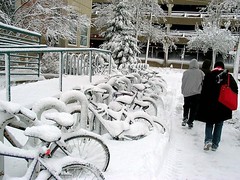
Briefly, let's hit the high points. First, why would anyone want to ride in the cold? For big, 'thermally efficient' guys like me, cold weather is simply more comfortable. But if you've ever experienced the thrill of riding a bicycle along a snow-covered road just after dawn when the whole planet seems to be still and silent, almost as if holding its breath in anticipation of the coming day, you'll understand the fascination. The air seems crisp and clean. Your tires crunch across hard packed snow. Barking dogs and cars can be heard a long way off, yet the freshly fallen snow muffles their noises.

But you can't enjoy moments like this if you're freezing. Adding some items to your regular summer kit will extend the riding season well into the fall or even allow you to ride all winter. Let's cover the cold weather basics starting with the base layer. Long johns, both tops and bottoms, are a winter cycling essential. Avoid cotton because it will not keep you warm if you sweat, and believe me, you can still sweat copiously in cold temperatures. Get polypropylene, silk, or wool longs. There are different weights for different temperatures. You'll be comfy with a layer of warm, dry air next to your skin.

Next is the mid-layer, the insulation that retains body heat. Just like the base layer, there are different weights (or thicknesses if you prefer) so it's possible to tailor your mid-layer for the conditions. This takes some judgment and experience. Generally, if you start out feeling warm and comfortable, you'll feel like you're riding in a sauna before many miles have passed. I have a variety of thin, medium, and thick sweaters, as well as a couple of vests, allowing great versatility.

Cold weather comfort comes from layers of clothing. Wear two thin mid-layers rather than a single thick one if conditions warrant, especially if they're changeable. You can peel one off if you get too warm, so try to have something to carry it like a seat bag with a long strap or even a fanny pack or Camelback.

Your outer layer provides protection from rain and wind, and retains all that nice, warm air. I use simple nylon windbreakers and carry a separate rain jacket in a pannier. Goretex is an alternative, but I've been too tight to buy it. Besides, most of the Goretex clothing is either cycling-specific or seemingly built for mountaineering . There are some wind stopping fleece jackets that do an admirable job of providing both wind protection and some additional warmth. They're water resistant too, and probably a better choice in wet conditions that a simple nylon shell.

Up to this point, I haven't mentioned any winter clothing that's cycling-specific. There's one article of clothing that is indispensable, though, and that's a good pair of cycling tights. Worn over a pair of long johns, they'll keep you warm well below freezing. And just like long johns, they come in different weights. I like the bib double-front ones because they offer an extra layer over the chest.

For the first time, this winter I'll be using some overboots. My old cycling shoes were warm enough for most cold weather, but the new ones are much better ventilated. While that's a bonus when it's 100F in the summer, at the other end of the temperature scale, it's a big minus. I may try some other ways to keep my feet warm, like wearing two thin socks or even using those neoprene socks made for hunting. I'm a big fan of old-fashioned wool athletic socks, but they're getting hard to find.

You may think you need thick socks and heavy gloves to keep warm. Sometimes it's easier to simply wear a hat or a vest. The head is an excellent radiator because roughly a quarter of your blood flows through it. If you keep your head warm, the blood going to the extremities is warmer, thereby keeping your hands and feet warm. Likewise, if you think of your torso as the body's furnace, you can put on a vest and force more heat out to the extremities. Even a bandanna or scarf around your neck will help trap more heat under your jacket.

Another way to keep your face warm is to grow a beard and mustache for the winter. This only applies to part of the population, however. Motorists look horror-stricken when they see a cyclist with icicles hanging from his face!

If you commute in cold weather regularly, there may come a time when you look outside and see big, fat snowflakes drifting down, slowly covering the street with wet slush. Some weird part of your brain will insist that it's a good day for a ride. If this happens, it's time to consider engaging in the cold rain, mud, and perverse fascination of cyclocross.


Labels: