Wednesday, April 23, 2008

Tulsa Tough Kids...

Kids1 Presentations


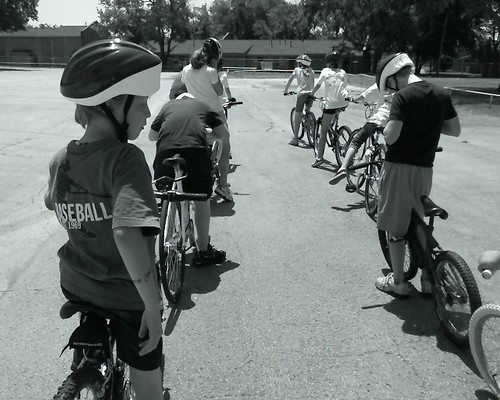
Monday and Tuesday evenings, the Tulsa LCI group did Kids1 presentations at Webster High School and Carver Middle School in Tulsa. Actually, we're offering an amalgam of Kids1 and Kids2 in the League of American Bicyclists curriculum because the kids who attend these events will receive new bicycles through the Tulsa Tough program. We want them to be prepared to ride safely.


The LCI group consists of Ren Barger, Gary Parker, Brian Potter, and me for these events. We followed the Crime Commission's “Safe Escape” program which teaches kids how to avoid abduction. Safe Escape is a free presentation they offer to any interested organizations in the Tulsa area, and to be blunt, it's a tough act to follow. We're bland and boring by comparison.


Watching Gary and Ren work with the kids is always enjoyable. They both have the light touch that develops almost instant rapport. Brian does the 'expert instructor' role, and I provide comedy relief. I'm lucky to have straight guys like these.


We watched 'A Child's Eye View' which is a short video on cycling safety produced by LAB. Gary asks the kids to watch for the mistakes the kids in the video make, and they're on it like hawks. He doesn't tell them what to look for – he merely asks, “What did you see?” The kids don't miss much. They tell us of a kid riding on the wrong side of the road, running stops signs, riding without a helmet, and riding out onto the street without scanning for traffic first. Honestly, they didn't miss a single mistake.


I was lucky to have Jordan along on Monday evening. On the drive to Webster, I told him to expect a question about how taking Road1 and learning the rules of the road helped him when he took his driver's license test. Brian called on him during the lecture and Jordan responded very well. Afterward, six or eight kids gathered around to ask him more questions. The LCIs are impossibly old by kids standards, but Jordan is closer to their age and easily approachable. I think he was a bit surprised by the attention.


Today (Wednesday) we get to assemble those new bikes – all 300 of them. Last year, we had an enormous group of mechanics, box haulers, pizza technicians, and other support people. The team assembled 200 bikes in about 90 minutes. I'm hoping it goes as quickly tonight.


In May, we'll do the skills and drills portion and the kids will get their new bikes and helmets. That will be intense because we'll have 3 classes each day. After that, there's a planning meeting for the tech support staff, and the two-day Tulsa Tough event itself. I've been having short nights and long days already, and I'm only peripherally involved in the Tough. Those more centrally involved must be working their butts off!


So if you participate in any of these big events, whether it's a local charity ride or a big racing weekend, take a moment to thank the volunteers. And don't be surprised if you find one of us fast asleep in a chair during a quiet moment.


Labels: ,

Wednesday, March 12, 2008

Hey!!!!


(Image from Sonoma County Transit - Top ten crashes and how to avoid them. Good advice.)


Fritz sent me a link that leads to a test of your powers of observation.


http://www.dothetest.co.uk/


Click on the link (it requires a broadband connection) and test yourself.


Seeing is an active process. The act of vision is filtered by our expectations and preconceptions. So when a motorist says, “Officer, I never saw that cyclist. He came out of nowhere!” That motorist is likely telling the truth.


Now, you'd think that as a cyclist I'd be more aware of other cyclists on the road. And in a general sense that's true. But just like everyone else, I'm shackled to my expectations when I'm driving. Several times, I've been startled by wrong-way riders or night riders seemingly appearing 'out of nowhere.' It's an unpleasant experience.


The incident I'm about to describe happened some time ago. Fritz reminded me of it during his appearance on the Spokesmen earlier this week.


The sun lurked just over the horizon that morning, lighting the road with indirect sunlight. Dawn was moments away. I was southbound on Mingo Road just north of the maintenance base where I work. A car pulled up and stopped on a side street. Yes, it's the classic motorist-about-to-pull-out-in-front-of-you position. I could see his eyes turn past me and look far down the road. The small, comparatively slow moving bicycle with a big, “well nourished” guy on top simply didn't register. The driver's programming had him looking for large, fast-moving vehicles much farther away. So while I was in his field of vision, I didn't make a blip on his radar. And radar is a good analogy because Doppler radar works by showing speed differences, and below a certain threshold, those differences are disregarded. This driver's eyes were turned toward me, but I didn't break that critical threshold of consciousness. He scanned for 'real' threats, motor vehicles hurtling toward him at 50 miles an hour, not a bicyclist traveling at 15.


I instantly moved to the left hand tire track, ready to brake or dodge as necessary. Sure enough, the car started forward. I yelled, “HEY!” The car nose dived as the driver spiked the brakes. He had the startled where-in-hell-did-you-come-from look on his face.


Labels:

Friday, October 19, 2007

American Lawbreaking and Traffic Policy

(Image from Daily Placebo)

What follows are two stories that are related in a sense. The first part is from Tim Wu on Slate. He discusses American lawbreaking and and the forces that cause all of us, ordinary citizens, lawmakers, law enforcement, and the judiciary, to turn a blind eye toward some aspects of our laws. His article is in five parts, too long to include here so there is a brief excerpt below. I've included the excerpt about narcotics as an example, not as an advocacy piece on drugs. That's a thorny subject worthy of more nuance and depth than my post.

Since I'm a bike commuter and League of American Bicyclists instructor, bicycle safety is a big part of my focus on CycleDog. Laws that effect our ability to ride on the road are often misunderstood, misapplied, or simply ignored. The apparent goal of traffic planning it to facilitate motor vehicle travel, in effect increasing convenience for motorists to the detriment of cyclists and pedestrians. While we lobby for new, more effective laws intended to make our streets safer, we must acknowledge that these efforts will be futile if the laws are ignored or unenforced. As Wu points out ...tolerance of lawbreaking constitutes one of the nation's other major—yet most poorly understood—ways of creating social and legal policy. Almost as much as the laws that we enact, the lawbreaking to which we shut our eyes reflects how tolerant U.S. society really is to individual or group difference.” In effect, the almost universal disdain for speed limits reflects our society's view that exceeding the limit is acceptable and that the resulting carnage is acceptable too. Periodic enforcement actions meant to reduce speeding have merely temporary results. Likewise, the occasional enforcement action targeting cyclists who run stop signs is merely another temporary irritation. As soon as the cops are gone, traffic returns to normal.

But should it be that way? Traffic law is meant to provide a common template for behavior and thereby make traffic predictable. This predictability enhances the safety of all road users.

Motorists and cyclists, however, have different perceptions of safety. Another way of describing that is to say they have different ideas regarding risk, both real risk and perceived or imagined risk.

A ton or more of steel and glass gives the occupant a much different view of safe road behavior as opposed to wearing a Styrofoam hat and a couple layers of fabric. This difference was illustrated by a comment from a combat infantryman when he was asked about a new uniform he'd just been issued. “It's good,” he said, “but the buttons keep you too high off the ground.” While it's clearly a facetious comment, the buttons wouldn't be an issue for someone riding in a tank or an airplane. That infantryman had an entirely different view of personal safety involving factors that are of little or no concern to other military personnel.

That's equally true of cyclists and pedestrians. We have different issues regarding road safety, and our perception of safety is very much different from that of motorists. While it's certainly desirable for cyclists and motorists to share a common understanding of the rules of the road, cyclists need an additional skill set and an additional awareness of road hazards on top of that common understanding. We are at risk from things that a motorist simply doesn't see, like patches of sand, wet leaves, railroad crossings, or painted road surfaces when they're wet. That can lead to misunderstandings and conflicts. When a motorist understands why cyclists need to zig-zag across angled railroad crossings, for instance, they're less likely to crowd a cyclist or try to overtake him. Ideally, we'd address these conflicts through education programs aimed at both cyclists and motorists.

Our current transportation policy accepts 42,000 deaths as just another cost of having a modern highway system. Yet when we propose ideas to reduce those deaths, ideas like traffic cameras, more stringent driver's ed training, more enforcement of traffic laws, we immediately experience resistance. The public expects to go as fast as possible as often as possible. Road planning values convenience and speed over other considerations like safety, noise, stress, or quality of life. Trust me, when it's nearly impossible for an able-bodied adult to cross an urban street even at a signalized intersection, the negative effects of traffic are a quality of life issue. Cyclists and pedestrians are widely assumed to be not as important to road policy as motoring interests.

I don't expect that Americans would tolerate an extensive CCTV system like that used in the UK. Likewise, since the interstate highway system and similar high-speed roadways are fairly safe, it makes little sense to attempt to 'improve' their safety with reduced speed limits. But there's another proposal mentioned in the second piece below, an easily implemented law that would have a genuine impact on unnecessary deaths by reducing the speed limit in urban areas to 20 mph. That would be across the entire metro area and would include all streets. I'd expect that some motorists would rail against it, of course, because there's nothing as onerous as having to drive slowly. There's no question that it would reduce injuries and deaths, reduce noise, save fuel, and make our cities more liveable less stressful places.

............Ed


=========================

American Lawbreaking

from: Tim Wu

Introduction

Posted Sunday, Oct. 14, 2007, at 8:03 AM ET

...As this story suggests, American law is underenforced—and we like it that way. Full enforcement of every last law on the books would put all of us in prison for crimes such as "injuring a mail bag." No enforcement of our laws, on the other hand, would mean anarchy. Somehow, officials must choose what laws really matter.

This series explores the black spots in American law: areas in which our laws are routinely and regularly broken and where the law enforcement response is … nothing. These are the areas where, for one reason or another, we've decided to tolerate lawbreaking and let a law—duly enacted and still on the books—lay fallow or near dead.

...But tolerance of lawbreaking constitutes one of the nation's other major—yet most poorly understood—ways of creating social and legal policy. Almost as much as the laws that we enact, the lawbreaking to which we shut our eyes reflects how tolerant U.S. society really is to individual or group difference. It forms a major part of our understanding of how the nation deals with what was once called "vice." While messy, strange, hypocritical, and in a sense dishonest, widespread tolerance of lawbreaking forms a critical part of the U.S. legal system as it functions.

That Other Drug Legalization Movement

...what's particularly interesting about the Experience Vaults is how many of the drugs reviewed there aren't actually classic "illegal drugs," like heroin or cocaine, but rather pharmaceuticals, like Clonazepam.

That's because over the last two decades, the pharmaceutical industry has developed a full set of substitutes for just about every illegal narcotic we have. Avoiding the highly charged politics of "illegal" drugs, the pharmaceutical industry, doctors, and citizens have thus quietly created the means for Americans to get at substitutes for almost all the drugs banned in the 20th century. Through the magic of tolerated use, it's actually the other drug legalization movement, and it has been much more successful than the one you read about in the papers.

...Over the last two decades, the FDA has become increasingly open to drugs designed for the treatment of depression, pain, and anxiety—drugs that are, by their nature, likely to mimic the banned Schedule I narcotics. Part of this is the product of a well-documented relaxation of FDA practice that began under Clinton and has increased under Bush. But another part is the widespread public acceptance of the idea that the effects drug users have always been seeking in their illicit drugs—calmness, lack of pain, and bliss—are now "treatments" as opposed to recreation. We have reached a point at which it's commonly understood that when people snort cocaine because they're depressed or want to function better at work, that's drug trafficking; but taking antidepressants for similar purposes is practicing medicine.

============

Safety group urges 20mph in urban areas to save lives


Dan Milmo, transport correspondent

Tuesday October 16, 2007

The Guardian


Motorists will face a mandatory speed limit of 20mph in residential areas if the government accepts proposals that would reduce the annual death toll of 3,100 people on British roads.

The measure could help to cut fatalities by two-thirds to 1,000 a year, according to the influential Parliamentary Advisory Council for Transport Safety (Pacts). The current speed limit in built-up areas is 30mph but Pacts has urged the government to issue guidance to local authorities, which control speed limits on minor roads, demanding tighter restrictions.

Robert Gifford, executive director of Pacts, said the measure would save lives by reducing accidents on residential and shopping streets, while encouraging walking and cycling. According to Department for Transport statistics nine out of 10 cyclist and pedestrian casualties occur on built-up roads. "A 20mph limit in built up areas ... will help create an environment where people are not afraid to walk or cycle. And it will make a contribution to issues such as climate change and sustainability," said Mr Gifford.

The proposal is published today in a Pacts report, Beyond 2000, that calls for tough targets on road deaths and injuries. The government is aiming to reduce casualties, compared with 1994-98 numbers, by 40% by the end of the decade. It also wants the number of children killed or seriously injured cut by 50%. So far it is exceeding the child target but is lagging on the overall figure, which has prompted calls from road safety campaigners for a change of strategy.

France reduced fatalities by a third between 2001 and 2005, compared with 7% in the UK, although ministers said that the figures did not take into account the fact that Britain had focused on road safety decades earlier than many other EU countries.

The DfT said it supported 20mph zones but the decision on implementing them should be left to local authorities as in Portsmouth, where the city council is imposing a 20mph limit in residential areas. A spokesman added: "Previous research has shown that 20mph limits are only effective when vehicle speeds are already low or where additional traffic calming measures are implemented."

Edmund King, executive director of the RAC Foundation, warned that drivers would not accept a blanket speed limit in towns and cities. He said there was no doubt that 20mph speed limits would improve road safety, "but some motorists might not understand or accept them [blanket limits] and it could backfire".

Labels: ,

Tuesday, July 17, 2007

Safe Routes to School

Another response to Kelley, who was concerned about getting her children to and from school safely:

As you've already noted, drivers exceed the speed limit regardless of their proximity to schools, and it's simply not possible for police departments to provide enough officers to enforce the laws. I live in Owasso. Fifteen years ago, there were rarely more than 3 patrol cars on duty at any time. I think they may have 6 or 8 on patrol now, and we have 12 schools. The PD just can't cover every school every day, though to their credit, they do a good job when a problem is reported. When a speeding problem is identified, they'll put extra patrols on that area for a time. Traffic gets 'calmed' but the effect is temporary.

Traditionally, we've relied on a triangle of ideas that support cycling and cyclists: enforcement, education, and engineering. Like most citizens, I prefer proactive police work that mitigates or eliminates problems while they're small, rather than waiting for the other approach, an officer showing up to take a report after something bad has already happened.

Most but not all of the local elementary schools are in residential areas served with neighborhood streets having 25mph speed limits. Most parents won't let their kids ride bicycles to school on these streets because others are simply driving too fast. The kids who do ride stay on sidewalks. Honestly, I can't understand the compulsion to drive fast through a neighborhood when children are going to and from school, and I particularly do not understand why people feel their need to get their own kids to school on time somehow justifies putting someone else's kids at risk. But that's a rant for another time.

I'll return to sidewalk riding in a moment, but first I'd like to talk about bicycling education. Most of our BikeEd focuses on adults riding on the road. There's a good reason for this. John Forester pointed out that most grade school children (most, but not all) don't have the judgment skills necessary to ride unsupervised on the road with traffic. Given my own experiences riding with children, I'd have to agree. But your son is in that 12-13 year old range where he could begin learning those skills. I've told kids that their bicycle is the first step to driving a car. It can be an opportunity to learn the rules of the road and some of those critical judgment skills so necessary to a new driver. This assumes a parent is willing to learn the fundamentals of road cycling, and that they're able and willing to spend the time on the road with their kids. It isn't easy. There are those heart-in-your-mouth moments, times of incredible frustration and exasperation, and moments of pure gold.

So bicycling education, then, is primarily focused at the individual level. It would be nice if we could get a curriculum into the public schools, and I believe there is some effort in that direction, but I'm not at all familiar with it, so I hope someone with better information can step in. Teaching BikeEd in the schools would get the information out to a much wider audience, hopefully with a greater impact.

The other side of the triangle is engineering. The goal is to change behavior by providing infrastructure that causes people to act in defined ways. Ideally, we'd have a network of multi-use paths connecting neighborhoods with schools, parks, shopping centers, and retail stores. But we live in a far from ideal world. Given the infill around neighborhood schools, building MUPs is impractical. Providing a bike lane may seem to be a solution, but I'd have reservations about permitting a young child to use one unsupervised. The SRTS material included some information on walking buses and bicycling buses, if I recall right, in which groups of kids travel to school together under adult supervision. This diverges from the facilities and engineering to some extent,because it's relying on a presumably informed adult to shape child behavior, but the necessity of good roads and signalized intersections should be fairly obvious.

None of our triangle's sides can exist independently of the others. None of them alone provide a solution to the problems we face as cyclists and parents of cyclists. Yet when we acknowledge the limitations inherent in both law enforcement and engineering, bicycling education offers a practical approach to dealing with problems, though admittedly it's at the individual level rather than societal.

Labels: ,

Monday, July 16, 2007

Tulsa trails...

This was my response to a well-meaning plea for bicycle trails servicing area schools:

Building trails that provide connectivity is certainly a laudable goal. But as always, the devil is in the details. There are a host of questions:

- Where does the right-of-way come from? Most schools have residential housing adjacent. Whose homes will be demolished to make right of way? Think about the elementary and middle schools in your area. Would it be possible to build a trail system that accessed those schools?

- Assuming the right of way can be found, how do you fund the construction? Trails cost roughly $1 million per mile. Should it come out of the school's budget, or is it more the sphere of public works or parks? Does it involve city,state, county, tribal, or federal land? Each entity has to sign off on the plan.

- Who will maintain the trail, or more directly, whose budget will pay for it?

If you're beginning to get the idea that planning and building a trail network involves a multitude of questions, compromises, competing interests, and protracted bureaucratic infighting, you begin to understand why they're difficult to bring into existence. A trail idea will not meet with universal acclaim. Quite the contrary, in fact. The NIMBYs, naysayers, and simple obstructionists show up at every public meeting. They can be quite vocal, and more importantly from the political classes point of view, they vote.

But that's just the political and planning end. Even if you have a trail system, parents have to permit their children to use it. Given the "stranger danger" paranoia that infects so many parents, can we really expect them to let their kids ride a bicycle to school? It would be pleasant to think that one or more parents would ride with them, but the days of Ozzie and Harriet are long gone. If I recall right, less than 20% of families have a stay-at-home Mom. Chances are, both parents are hustling off to work. There isn't time to ride a bike.

Before anyone brings up the idea of bikelanes that service schools, or the idea of utilizing existing sidewalks for the same purpose, let's remember that bikelanes complicate intersections and traffic interactions for adults. Children would have a much harder time negotiating such intersections. And sidewalks offer another level of complication as kids don't obey stop signs and motorists simply don't look for cyclists on the sidewalk. The crash rate is 3 times higher than it is on the street.

I attended an INCOG planning meeting some time ago when they made the initial proposal for the trail network in their service area. One of the planners said the typical timeline is 10 years from concept to completion. And that's true if there are no major complications. Tulsa's trail network is nearing completion, and despite it's wide-spread nature, it doesn't allow full connectivity in that it doesn't fully connect neighborhoods with schools, parks, businesses and shopping. You have to ride on the street to reach many destinations. That will always be true. However, the on-street bicycle route network complements the trail system by using lightly traveled neighborhood streets.

But think again about what I said about stranger danger. Do parents allow their children to use the existing trails and bike routes to reach their schools? Has anyone ever done a count of students biking to and from school on a regular basis? I think that would be interesting information to have before tying to launch a construction project.

Labels: , ,

Friday, June 15, 2007

A teachable moment...


I was riding home last night, thinking about stopping at the car wash to clean the Bianchi. It's grungy from being ridden in the rain. I really need to put some fenders mudguards on that bike. Cleaning a bike with a pressure washer is easy, provided the spray isn't directly into the hubs or bottom bracket.

But as I was grinding my way up 129th, a few cars stacked up behind me due to oncoming traffic. One of them decided to lay on the horn. Two teenage kids were in a beat up old Ford Ranchero a couple of cars back. When traffic thinned, they came up alongside and the passenger yelled the traditional, “Get up on the sidewalk!” They jetted off.

But God in His infinite mercy, decided to make the traffic light at 86th turn red. OK, maybe it wasn't God. Maybe it was the Public Works department, or it could have been someone in Public Works who only thinks he's God, a fairly common occurrence. This would mean we live in a polytheistic universe ruled by bureaucrats in cheap suits. I don't want to think about that. On the other hand, we could be living in a universe where every detail of our lives is predetermined by an arbitrary god. Sometimes it's hard to tell the difference.

Anyway, the light turned red. The Ranchero stopped. I grinned as I rode up alongside it. This makes people uneasy for some reason. I suppose they expect that a cyclist will be pissed off and angry, but when a 220 pound guy shows up with a huge smile, they get a little nervous. It's like getting into a minor fender bender and discovering a grinning Tony Soprano getting out of the other car.

I rolled up next to the passenger door. The kid looked shocked that a mere cyclist would have the effrontery to engage in a confrontation. But he rolled the window down. I switched to 'pedantic mode' and did my best Brian Potter impression.

Fellas,” I said, “it's illegal to ride on the sidewalk.”

Whaaaa?” he replied. He stared up in slack-jawed wonder at a big, middle-aged guy leaning down from a bicycle.

It's illegal to ride on the sidewalk. Besides, it's about three times more dangerous than riding on the street.” I held up three fingers for emphasis.

It's illegal?” Obviously, not the sharpest tool in the shed. Maybe he had to take his time counting all those fingers.

Yeah, that's why I don't do that.” The light changed. Both the driver and passenger were staring at me. “It's green. Go-go-go!”

They went. No gestures, no shouts, no honking horn. I'd like to think they were just a little bit better informed about cyclists and that the brief encounter served an educational purpose. Or, on the other hand, maybe they thought they'd just met Tony Soprano on a Bianchi.

Labels:

Sunday, May 20, 2007

Tough Kids: Part One


We had our first Tough Kids class yesterday, a preparatory event for the Tulsa Tough weekend. Malcolm McCollam received 300 donated bicycles for the Little 100, and he needed only 200. We had 100 bicycles give away to area kids who attend both the Tough Kids class and the kick-off for the Tulsa Tough on June 2nd.

The class was scheduled from 10AM to 2PM. Instructors and volunteers were there earlier to set up some tents for registration and the mechanics. We were lucky to have about 10 instructors and volunteers, so the day really went smoothly. Kids and parents started trickling in at 9, and we were underway just after 10. We had a full class of 50.

We did the usual parking lot drills: learning to scan for overtaking traffic, the rock dodge, quick stops, and quick turns. The quick stops were difficult for some of the kids on coaster brake equipped bikes. I rode one of the Schwinn Little 500 bikes around the parking lot, and frankly, I'm not comfortable with coaster brakes, either. The bikes handle like any other road bike, not a track bike, though they strongly resemble one. Perhaps I have fixed gears so firmly ingrained in my bicycling consciousness that a coaster brake is just too foreign. The very idea of back pedaling just seemed wrong somehow.


Allow me to belabor the obvious. Teaching kids is much different from teaching adults. First, the kids regarded the parking lot drills almost as a challenge. They were eager to try them. Adults are put off by the quick turn in particular. They're hesitant to make the attempt since they 'know' counter steering is somehow dangerous. So in teaching adults, we have to get past what they already 'know' in order to do this drill. Also, kids don't need a wealth of explanation. Providing too much detail only confuses them. Jordan said, “Yeah, and it's boring!” They like it short and sweet. On the other hand, it's much harder to keep a group of kids focused on the lesson. Gary Parker, a retired teacher, said, “Welcome to middle school, Ed!”

I told my group that the important part of the instruction was to learn some new skills and to have fun doing it. The kids seemed to enjoy it because it was fast paced. No one had a chance to stand around for long and get bored, except for a couple of teenagers. Then again, when it's painfully obvious that they'd rather be anywhere else but in a parking lot on a Saturday morning with a bunch of totally un-cool bike geeks, well, the carefully studied appearance of crushing boredom is entirely understandable.


Several parents asked about bicycling events in the area, especially events for their kids. Brian and I talked with some about the various tours. There was one teenager asking about racing opportunities. I told him about the Tuesday evening criteriums. It would be helpful to have some handout information on area tours and races for these requests. Those teens are the next crop of cyclists.

We need to add to the instruction for the next event. We need to emphasize the dangers of sidewalk riding because some of the kids rode away from the event on the sidewalk. We need to explain lane use before going on a group ride. I had one boy who swerved from the curb all the way across the centerline, regardless of traffic. I, um, admonished him loudly, and told his Mom about it after the class. “Good!” she said, “Sometimes that the only way to get his attention.” Besides the name tags on the front of their shirts, it would be good to have a piece of masking tape with their names attached to the back of their saddles too.


I learned some new things, as is almost always the case. I saw some kids beaming from the praise they received. It's exciting to see them develop physical skills, and watch as they improve on each attempt.

And I learned from Ren that 'dude' is a non-gender-specific term. Personally, I would not be comfortable calling a female-type-person 'dude' so perhaps that's an indication that I'm out of touch, over the hill, or otherwise middle-aged. Of course, she could be pulling my leg. How would I know?

Labels: , ,

Sunday, April 22, 2007

Sunday Musette

Tulsa Little 100

OK, so this is technically Sunday, but most of the following is about yesterday. First, there's this bit from the Tulsa World about the Little 100:


By Staff Reports
4/22/2007

Sts. Peter and Paul Middle School student John Yuan (left), 13, swaps bikes with teammate William Berntson, 12, during the Little 100 Relay Race at Webster High School on Saturday. Students who participate in the event get a chance to win free bicycles. The bike giveaway is sponsored by the Warren Foundation and St. Francis Children's Hospital.


Adam Vanderberg, owner of Lee's Bicycles, and an army of volunteers deserve a huge thank-you as recognition for their efforts on this event.

Tom's Bicycles


Also, I talked with Tom Brown yesterday. He's opening a new shop at 15th and Rockford (Cherry Street to some of you) across from Subway. Tom is very excited about it! For that matter, so am I 'cause it's tons closer to my house. I'll write more on this as it develops. The shop should be open this summer.


An Observation...

As Jordan and I drove through town on the way to Tom's, we spotted numerous people riding bicycles, probably 12 to 15 in all. And of all those folks, only ONE was riding on the road. Though to be fair, he was most likely riding on the road because he didn't have a choice. There wasn't a sidewalk. Also, he was riding one-handed because he held the handle of a push mower in the other one. I wish I had a photo of the guy towing his power mower along Mingo Road.

All the other people on bicycles were riding on the sidewalk. One of them crossed Memorial Drive in a pedestrian crossing while traffic swirled around him. Jordan watched it all in astonishment. So did I.

The city of Tulsa wants to gain bicycle friendly status. We have a long ways to go just in educating cyclists, let alone the motoring public.

Labels: , , ,

Thursday, April 19, 2007

Tulsa Tough Bicycle Giveaway....

It was lunchtime. I'd just put a peanut butter cracker in my mouth when my cellphone rang.

Helloph?” I mumbled around the cracker.

Sandra was on the line. “Hello? Ed?”

I swallowed hard, dry cracker dust and peanut butter coating my throat and making my voice raspy. “Yeah, it's me.”

Sandra had just taken a call from Malcolm McCollam. Malcolm has a hundred surplus single speed bikes with coaster brakes that were donated for the Little 100. He wanted to know if we could do a kids class and give the bikes away to those kids who attended it and the kickoff for the Tulsa Tough. To receive a bike, a kid would have to attend both the class and the Tulsa Tough kickoff.

Currently, the plan is to offer two "Tulsa Tough BikeEd" classes on the last two Saturdays of May from 9:30AM to 2PM. At this time, it will most likely be held at the West Festival Park.

The Tulsa Tough will be held the weekend of June 2nd and 3rd. The Tulsa Tough is both a tour and a race, with the race being the premier event of the 2007 season. The kickoff will be a ride down Riverside Drive behind a police escort at the start on Saturday. The kid's ride will loop back to the start area.

We will need experienced cyclists willing to volunteer their time assisting with the BikeEd course. Ideally, we'd like a ratio of 5 kids to each volunteer.

League of American Bicyclists instructors will be leading this program.

Labels: , , ,