Sunday, February 20, 2011

I saw the strangest things...

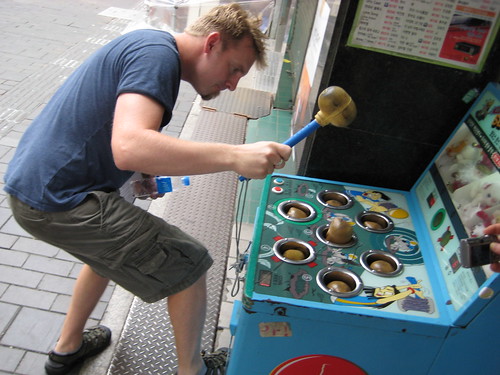
I've had a stressful week, so what better way to relax than by going out to take photos most of the morning. Sometimes, it gets a little weird. That kid in the middle is my son, Jordan, and those people around him are...well...typical suburbanites. Yeah, that's it, typical. I have no idea why they were doing this and they remained mute. It's just another of life's mysteries.

And I didn't take the picture. Mary took it with Jordan's cellular phone. I did, however, drive around looking for them so I could try to get an interview. No luck.


Who needs Photoshop, Pixia, or Gimp? I did this in plain old MS Paint. If I ever learn how to use those other programs, I'll probably get in trouble.


Here's the bicycle advocacy portion for today. This pothole was forming prior to our two snow storms, but since then it's become deeper and wider. For anyone on two wheels, crossing these railroad tracks is going to be problematic. Sure, wider tires on motorcycles and scooters don't slip sideways as easily as narrow bicycle tires, but the pothole may cause those heavier vehicles to have problems here too.

The railroad crossing is on a slightly built up right of way. This means that as you approach, you cannot really see the roadway between the rails. This slight hump is apparent in the next two photos.

That's a Minolta Autometer IIIF and it's about 6 inches long, nearly as long as the pothole is deep.

Here's a view to the south showing the oblique angle of this crossing. Several cyclists fall here each summer. I've nearly fallen when the rails were wet. The safe way to cross, of course, is at a 90 degree angle, and that's possible provided there isn't much traffic. Motorists don't know or simply don't care that it's illegal to pass within 50 feet of a railroad crossing.

Here's the view looking north.

I'll write something about this for the Examiner, and include a link to the Flickr versions of these photos. They include GPS information.

Labels:

Sunday, March 07, 2010

ChipSeal

Reed Bates has been stopped numerous times by the police in and around Ennis, Texas. Most notably, he was arrested and jailed for the 'crime' of riding a bicycle on the road. Yes, he was on the roadway, not the shoulder, so the county sheriff's department decided he had to be taught a lesson.

Like most states, Texas forbids motor vehicles from using the shoulder. Cyclists are permitted to do so, but they are not legally obligated to ride on the shoulder. Rather than charge Bates with violating a non-existent law (a practice that's not unusual) the police charged him with impeding traffic....on a four lane road.

Now, correct me if I'm wrong, but when there are two lanes in the same direction, isn't one of them often called the 'slow lane' and the other the 'passing lane'? Motorists pass slower traffic all the time, yet when it's a bicyclist in that slow lane, somehow a crime just had to be in the making.

Bates was tried and convicted by a jury of his peers - not a cyclist in the bunch, obviously - and his case is now on appeal. That is, his case will be appealed if we can raise enough money to contest this unfair treatment. Please, please, please, visit this website and make a donation however small and do something to stand up for a cyclist's right to use the public roadways.

And where are LAB and the Texas Bicycle Coalition in all this? That sound you hear is crickets chirping.

Labels:

Wednesday, December 16, 2009

2009 MUTCD

The 2009 revison of the Manual of Uniform Traffic Devices is available on line at:
http://mutcd.fhwa.dot.gov/kno_2009.htm

This is the standard reference book for signage, lane markings, and more. It's useful to cyclists when a local body wants to adapt non-standard devices, and can be instrumental in assisting cyclists involved in advocacy.

Labels: ,

Tuesday, September 15, 2009

Tesla Roadster and James Martin - Update

Fritz has a piece on James Martin's 'apology' regarding his weekend article on the Tesla Roadster. It follows the standard non-apology apology format so well known to all of us. I suspect his editor, publicist, and possibly his solicitor - attorney on this side of the Atlantic - did a little bit of arm twisting. He says the piece was intended as humor.

That's right, humor. It's the standard way of weaseling out of a situation like this. The cyclists he ran off the road just didn't have as finely attuned sense of humor as Martin. They didn't get the joke.

I'm tired. Some days this is too much like playing Whack-A-Mole.

Labels:

Thursday, September 10, 2009

Old North Road Update


County Commissioner Karen Keith and Tulsa County Engineer Ray Jordan held a meeting last night in Sand Springs about the widening and repaving planned for Old North Road. Gary Parker and I attended.

This project is scheduled to begin on September 21 and end on Oct 2, weather permitting, and will include only the western portion of the road, from 81st West Ave going west to Adams Road. It will include two 14 foot travel lanes and the fog line will be set back 1 foot from the pavement edge. This is not part of the traveled portion of the road. It's a buffer to prevent the road edge from crumbling.


The original plan called for two 12 foot lanes and a 4 foot bike lane along the west bound side only. When the maintenance problems were discussed, the plan was amended. A bike lane in this terrain would inevitably attract debris and it would not be swept clean by car tires. Additionally, there are places where sand and gravel would accumulate from washouts. Some cyclists would ride around them without looking for overtaking traffic, causing a hazard.

Another idea involved a three lane road way - two ascending lanes and one descending. This was not possible due to the limited right of way, topography, and corner radii.

There is support for a reduction in the speed limit along this road. Presently, it's a 40mph limit. The county can reduce that to 35mph but no further. There's a rule about speed limits in urban areas allowing the county to make further reductions if houses have less than 100 feet separation. That is not the case along Old North Road.

An alert reader pointed out that cyclists may be subject to speeding tickets after this change as they exceed that 35mph limit on the downhills.


Tulsa County engineer Ray Jordan and County Commissioner Karen Keith made it plain at the outset that the cyclists were not going away and that they have every right to use that roadway. This did much to quell any anti-cycling sentiments, though a few disparaging comments were made. Both Jordan and Keith are to be commended for their openness and genuine concern, not only for the residents of the area, but for those who are merely passing through as well.

This is a good compromise that will benefit both motorists and cyclists. Parker pointed out that the Wednesday night ride uses this route only 20 times per year if the weather cooperates, yet area residents gain a wider, smoother road surface for their every day use.

Labels: ,

Wednesday, September 09, 2009

Community meeting re: Old North Road

Gary Parker and I attended a community meeting in Sand Springs about the repaving/widening project scheduled for Old North Road this fall.

The short version - the project will begin later this month and is planned to be finished in 8 working days if the weather cooperates. Rather than 2 travel lanes and a bike lane, the project will have 2 14 feet wide lanes with 1 foot of pavement to the right of the fog line. A 14 foot lane is shareable.

The bike lane that was in the original plan was removed due to concerns about maintenance and debris.

This is a good compromise that will benefit both motorists and cyclists.

One last thought. Gary and I drove along the road west to east. It's signed for 40mph, but except for a brief section on one of the hilltops, I never got above 30. The road winds and is quite rough, so 30 mph was a judicious speed. There was some talk at the meeting about reducing the speed limit to 35.

I'll have more on this tomorrow, probably over on the Examiner page.

Labels:

Saturday, August 15, 2009

Oklahoma bicycling news

I came across two items of local interest. The first is from the Enid News and Eagle.

Excerpts follow:

Enid police say cyclists, pedestrians also must be just as vigilant as motorists on city roadways
(LINK)

By Cass Rains, Staff Writer
Sat, Aug 15 2009

People using Enid’s roadways are urged to exercise more caution and abide by the rules of the road.

Four fatalities have occurred on Enid roads this year, two this month.

“Motorists need to devote and pay attention when approaching slow-moving traffic, such as pedestrians and bicycles,” Enid Police Department Lt. Eric Holtzclaw said.

...People riding bicycles on Enid roads are required to follow the same rules as someone driving a car, he said.

Law requires bicyclists to “ride as close as is safe to the right-hand curb or edge of the roadway.” The law allows for exceptions such as debris or surface hazards, pedestrian or animals and parked vehicles.

...Oklahoma law requires vehicles passing a bicycle in the same direction to leave a distance of no less than three feet.

Holtzclaw said bicyclists need to ride on the far right of the road, with the flow of traffic, and in single file, not side by side.


Being the curious type, I went to the City of Enid website and found their local ordinances. As it turns out, Enid does have a mandatory sidepath law (Ord. 2004-28, 9-7-2004). In Oklahoma, this is a local option, not a state wide requirement.

But then we get to that pesky 'as far right as practicable' language. Enid's is just slightly different.

"A. Due Care: Every person operating a bicycle upon a roadway shall ride as near to the right side of the roadway as practical, exercising due care in passing a standing vehicle or one proceeding in the same direction" and "C. Riding Two Abreast: Persons riding bicycles upon a roadway shall not ride more than two (2) abreast, except on paths or parts of roadways set aside for the exclusive use of bicycles."

Let's give the good Lt. Holtzclaw credit for actually getting the intent of the law right when he said that cyclists are to ride as far to the right as is safe. This is a better choice of words than the unfortunate "practicable" or Enid's "practical" and it's the current form of the Oklahoma state law. "As far to the right as is safe" means every cyclist is entitled to ride in the lane in such a manner as to maximize his own safety. This doesn't mean he hugs the fog line because that is most definitely an unsafe position.

But then the good Lieutenant blows it by saying cyclists need to ride on the far right of the road and they must ride single file. They cannot ride two abreast. Enid doesn't have a law that prohibits riding two abreast. It says we cannot ride more than two abreast. If an overtaking motorist has to slow down or cross the centerline in order to pass a cyclist safely, he's not going to be more inconvenienced by cyclists riding side-by-side as opposed to single file. He still has the obligation to slow down and pass only when it's safe. When cyclists ride single file - especially if they're on the far right of the road - motorists will pass without changing lanes or straddling the center line. This is certainly convenient for motorists, but it's a hazard for cyclists. Safety always trumps convenience.

Like many in law enforcement, Lt. Holtzclaw seems to place a higher priority on traffic volume or throughput rather than cyclist's safety. It's not uncommon for motorists to be unaware of cycling laws, and indeed some of them are quite capable of inventing imaginary ones. But its unfortunate when law enforcement is ignorant of bicycling law and the best practices that cyclists can use to improve their safety on the road. This is not meant as a condemnation of Lt. Holtzclaw and the Enid Police Department. Instead, it's an indicates the minimal penetration of cycling law and best practices throughout the public. It tells those of us in advocacy there's a long, steep climb ahead.


This next piece was in today's Tulsa World. It's a small excerpt from a story about bridge and road improvements. Two of them - Old North Road and Avery Drive - are part of the Wednesday night ride route. Recently, that ride has been producing some conflicts between area residents, motorists, and cyclists.


Bridge, paving projects touted
West Tulsa County should have two new bridges and two repaved roads by year's end.
(LINK)

By GAVIN OFF World Data Editor

By the end of the year, west Tulsa County residents should welcome two new bridges and two newly repaved roads, one of which would have a bicycle lane, officials said Friday.

...Crews will repave the Old North Road from Adams Road to 81st West Avenue, just north of Sand Springs. The project will continue south on 81st West Avenue to about 10th Street.

Jordan said the repaving, which will likely begin next month and be finished within 30 days, is estimated to cost between $180,000 and $200,000.

It includes a 6-foot-wide bicycle lane, he said.

"Old North Road is very crooked," Jordan said. "It winds, and when you have people driving faster than they're supposed to on a crooked road, they can come up on bicyclists real quick."

A final west county project will repave Avery Drive from Chandler Park to Oklahoma 97. Jordan said that project should start in October and cost about $225,000.

This immediately caught my attention:
"Old North Road is very crooked," Jordan said. "It winds, and when you have people driving faster than they're supposed to on a crooked road, they can come up on bicyclists real quick."

So, the 'solution' is to attach a bike lane to one side of the road in order to facilitate those drivers who choose to speed? They're still going to overtake too fast. Maybe a better solution would be to spend the money on speed enforcement, you know, those people we pay to enforce the law for the safety of the general public. Also, I suspect this 'solution' will only increase the friction between cyclists and motorists. You see, the bike lane will be installed on just one side of the road. This lures cyclists into wrong way riding, and we can be certain that some area motorists will 'encourage' cyclists to use that lane regardless of their direction of travel.

You can attack a problem like this from the engineering end by making the roadway less amenable to speeding. Make it more narrow and winding. Throw in some bumps and potholes. Add those engineering features that serve to calm traffic. But putting a bike lane in so people can drive faster is simply asinine.

Or you can attack it from the law enforcement end. Isn't that one of the first complaints about cyclists - that we don't follow the law? Here's a wonderful opportunity to demand that motorists obey the law, rather than spend a big chunk of public money to enable them to go even faster.

Labels:

Sunday, August 02, 2009

Dr. Wally's Crank Index (update)

(Yam pointed out something I'd missed, so I added to the list. It went from 10 items to 11, and like the amplifier in Spinal Tap, that means it's one better!)

Dr. Walter Crankset of the University of Northeastern Oklahoma extension campus at Broken Elbow, has developed a quick indexing system to quantify the ignorance and anti-cycling bigotry found in so many letters to the editor. He named it the "Crank Index." He quickly pointed out that despite the similarity to his own name, he did not name the index after himself. "No," he said, "this is more accurately used to describe the crank factor in the letter writer's post. Obviously, higher is crankier."

(1)Bicyclists need tags, licenses, and insurance. There's a reason motor vehicle operators need these, and that's due to the enormous damage they can do to people and property. Licensing supposes that all operators have a minimal understanding of the law and can pass a test proving they can safely control an automobile. If cyclists caused similar levels of damage, public outcry would demand they be tagged, licensed, and insured also. Riding a bicycle does not absolve the cyclist of responsibility for any damages he causes.

(2) All bicyclists are scofflaws. They run red lights and stop signs all the time! No one comes to a complete stop at stop signs unless there's cross traffic in the intersection. They're treated as defacto yields. While it's true that some cyclists will run a red light, there's undoubtedly a greater danger posed by motorists who do so, trying to rush through an intersection while the light is still yellow.

(3) Public roads are for the use of all, and it's clear that bicyclists have an equal right to that public space. But they shouldn't ride on busy roads when there are other, less traveled roads and parks nearby. Cyclists have to reach their destinations, just as motorists do, so it's nonsensical to insist they cannot ride in proximity to other traffic.

(4) Bicyclists don't pay taxes. Roads funding comes from the general fund and everyone pays into that. There isn't a piggy bank somewhere collecting your tag, title, and gas taxes. Our roads are largely paid for via income tax, sales tax, and real estate taxes. Riding a bicycle does not absolve anyone of paying these taxes. If it did, the roads would be clogged with bikes.

(5) They impede traffic. If a given roadway has a minimum speed limit and a cyclist cannot meet or exceed that limit, he is impeding traffic. If there's no minimum speed, he is not impeding. The law (in Oklahoma) states that when a motor vehicle is moving at less than the speed of surrounding traffic, he is impeding. Bicycles are not motor vehicles in Oklahoma. They are legally devices propelled by human power.

(6) They should ride on the sidewalks. Most bicycling law forbids bicycle travel on sidewalks in business districts, and some municipalities forbid it entirely for adult cyclists. Regardless, riding on a sidewalk offers about three times the risk of collision as compared to riding in the adjacent street. If traveling on a sidewalk offers greater safety, maybe motorists should drive there.

(7) They should stay on the trails. These are very popular amenities, yet they serve little useful purpose unless they connect with popular destinations. There's no trail connecting my house with my work or the local grocery. Roads do that.

(8) Motor vehicles must slow down to avoid cyclists, risking a rear-end collision. Pardon me if I'm a little perplexed at this one. Speeding is a factor is about 13,000 deaths on our roads every year, yet you're complaining about having to slow down? Owning a car does not confer a Divine Right to Speed, yet many drivers seem to believe that anything that causes them to let up on the gas pedal is sinful, anti-social, and possibly illegal.

(9) Bicycle travel is dangerous. You may be right, but you'll be dead right. More people die from falls in bathtubs compared to deaths while bicycling. Perhaps we should outlaw bathtubs in order to save lives.

(10) They just don't have any 'common sense.' This one is lovely because it implies that anyone riding a bicycle in traffic is somehow deficient in common sense. Such feeble minded people have to be removed from our roadways for their own safety since they cannot recognize the dangers inherent in riding on the road. To which I say - bunk! Road cyclists are more aware than their motoring counterparts, and those who commute regularly in traffic have some of the lowest crash rates.

(11) They wear funny clothes that make them look gay. The basic cycling clothes haven't changed for decades. Like most sports apparel, function is more important than style, so bicycling clothing is meant to keep the rider comfortable over many miles and many hours in the saddle. And judging someone's sexual orientation by their clothing is about as reliable as determining their politics. "You know, that shirt make you look, um, Republican."

Dr. Crankset developed this for the use of all cyclists, and urged that results be kept in a common format, i.e., if 6 out of 11 statements appear in a given letter, the score would be 6/11.

Labels:

Wednesday, July 29, 2009

Anti-cyclist petition in Iowa

There's a lovely bit of rural bigotry cunningly disguised as a petition to ban cyclists from farm-to-market roads - essentially all county roads - in the state of Iowa. It's includes this slightly over blown prose:

Over the past ten years the number of bicyclists using these farm-to-market roads for recreational purposes has increased dramatically as have the number of preventable accidents and fatalities.

Rural commerce and citizens are significantly impacted when forced to share the farm-to-market roadways with bicyclists. Because of the growth of today's commerce and agricultural business, shared roadways are no longer safe or practical in today's society.

Gosh, the cows must be feasting on all those dead bodies. Nationally, the number of cycling deaths has been trending downward, though a slight uptick last year gave some of the busy bodies an opportunity to hyperventilate. I'd expect that Iowa is trending downward too.

So, absent a high body count, amputated limbs, heads lolling in the gutter, and the like, I think it's safe to say that the petition language is, um, suitable for spreading on Iowa's lush, green corn fields thereby making them lusher and greener.

It's a non-starter, folks.

Labels:

Thursday, July 23, 2009

Archer bicycle route


A group of local advocates is getting together later this afternoon to look at proposed changes to the city bicycle route presently aligned along Archer. There is some pressure to re-locate those pesky bicyclists off the arterial "for their own safety," of course, and it has nothing at all to do with gentrification and proposed angled parking. Nothing whatsoever. Never said it. Not gonna.

It's yet another exciting round of Whack-A-Mole!

Labels:

Monday, July 13, 2009

Traffic signals and stop signs

More breathtaking stuff over on the Examiner. Feel free to tear it apart! This time it's about signals and stop signs, and why some cyclists ignore them. I do not condone the common practice of running lights, though like most everyone else, I treat stop signs as yields.

And my thanks to Fritz for a little nudge.

I'm trying to post these informational pieces on Monday. Writing over there has forced me to adopt more structure, as in 'deadlines', in order to get things done. These are self-imposed and not set in concrete, but I think it's helping.

Labels: , ,

Friday, June 19, 2009

Bicycle commuter savings calculator

Kiplinger has a commuter calculator that's supposed to tell you how much you save by riding a bicycle to work and back. It asks you to plug in the round trip distance, parking fees, and any tolls. Then it gives you an estimate.

Now, I don't pay for parking or tolls, and my commute is 17 miles round trip. This calculator says I save $7.72 per day! That can't be right, can it?

Their methodology says that driving costs 55 cents per mile while cycling costs 19 cents per mile.

LINK TO CALCULATOR

Labels:

Thursday, June 18, 2009

Civil disobedience in Colorado

Fritz asked if I could write on this topic. I'm happy to oblige.

On July 25th, bicycle riders at Colorado's Sunrise Century may encounter some protesters. An unsigned flier urges area motorists to engage in "civil disobedience" by blocking area roadways with their vehicles as a means of protesting the state's new three feet passing law. Like similar laws in other states, the Colorado version requires that motorists pass bicyclists no closer than three feet. Some drivers object, saying that the new law puts them in jeopardy while they attempt to pass on narrow mountain roads with limited sight lines.

Yes, it's the motorists claiming they're at risk around bicyclists. They could collide with another motor vehicle when they blindly pass without being able to see if the roadway is clear. As we all know, a ton-and-a-half of steel and glass offers dubious safety around those pesky bicyclists, heavily armored in their Styrofoam hats and Lycra.


We have a word for motorists like this - whiners. Here's an excerpt from the news story:


Threats made to disrupt bicycle tour
posted by: Jeffrey Wolf written by: Dave Delozier

BOULDER - Alex Hearn has one word to describe the Sunrise Century: fun. It is not competitive and its primary purpose is to give people the chance to ride a bicycle through some of the prettiest canyons you will find anywhere.
Advertisement

So imagine his surprise when he learned this year's Sunrise Century was being targeted for civil disobedience. Hearn started to learn about it when fliers started showing up in mailboxes in the area of Left Hand Canyon north of Boulder. The flier carries a title of: "Civil Disobedience, July 25th Block Dangerous Cyclist Day, Boulder, CO."

...The flier goes on to say, "On July 25th in celebration of drivers' rights many cars will use the Left Hand Canyon Road, drive slowly and many may break down unexpectedly, blocking areas to the cyclists on the return leg of the 'Sunrise Century.' Please use judgment during this civil disobedience."

The Sunrise Century had already contacted the Colorado State Patrol and the Boulder County Sheriff's Office to provide traffic control and support for the ride. In light of the threat to disrupt the event, law enforcement officers may have an addition role to fill.

(MORE)

The news site had a photo of the note. Here's what I could read:


On August 5th new regulations limiting drivers rights regarding dangerous bicyclists will be STATE LAW.

CYCLISTS FLOUT COMMON SENSE, ENDANGER THOSE IN CARS ON MOUNTAIN ROADS IN THE NAME OF SELFISHNESS; CARS WILL BE FORCED TO CROSS DOUBLE YELLOW LINES ON DANGEROUS LIMITED VISIBILITY ROADS DUE TO THE EXPANDED RIGHTS OF CYCLISTS.

Yadda, yadda, yadda. Where to begin? Give the author credit for getting the spelling right, at least.

Naturally, I have much more to write on this topic. The rest of the post is over on the Examiner site. As usual, I couldn't resist a snarky response. It's a character failing.

Labels: ,

Sunday, June 07, 2009

CycleDog makes the top 50 list!

London Cyclist has a list of the top 50 cycling blogs, and CycleDog is number 45! Andreas writes that the list may have overlooked some other cycling blogs that should be included, so if you have a favorite that should be on the list, he's asks that you contact him. Sure, that could bump CycleDog, but so be it.

Honestly, it's a fine list that has many of my favorites, including Cyclelicious at number 10. Fritz ought to be happy with that!

Two that I'd recommend for the next list are Cycle Dallas and Commute Orlando because both are written by knowledgeable, experienced bicycling advocates.

Finally, my thanks to Andreas for including CycleDog.

Labels:

Sunday, March 29, 2009

Walmart and Bicycle Shaped Objects...


(Image from Consumerist)

A tip of the hat to George at Bike Riding Donut Guy for this....

Normally I wouldn't pick up on a story from another blogger, especially one like George, but Norman is practically right down the road from us, if you consider a hundred miles right down the road. My wife, She-Who-Must-Be-Obeyed, has had similarly negative interactions with Walmart and their return process. We've reached the point where we won't shop in there anymore if we can find the goods somewhere else.

I've met another bike commuter who used to ride back and forth to work on an ancient Huffy, an actual honest-to-god 10 speed that may have been manufactured during the Nixon administration. Now, it's absolutely necessary to tell you that the commuter is an aircraft mechanic, so he was able to stay on top of the maintenance. Regardless, the last time I saw the bike, its back wheel was almost square. He bought another one as a replacement. I don't think it lasted more than 6 months.

In a similar vein, there's The Bike of Doom, a blog about life on a $99 department store bike. Unsurprisingly, Steve has found that the true cost of keeping a cheap bike serviceable is more than the purchase price of a better one from a bike shop.


(What is wrong with this picture? CycleDog photo.)


All the above serves as a preface. Those of us with long years of experience view department store bikes - or 'bicycle shaped objects' - as poorly built machines meant to last a season or two at best. They're mechanically unreliable and often difficult to keep in repair. So while it's heartening to see that Keia recognized a shoddy product and sought to return it, the actions taken by Walmart's employee are reprehensible.

Remember, bicycles can be cheap, durable, or light. You can choose any two. But if you buy from Walmart, the only choice is cheap.

Excerpts follow.


Walmart Violates Company Policy, Pretends Not To Accept Bike Returns

By Carey, 5:00 PM on Sat Mar 28 2009

The Walmart in Norman, Oklahoma refused to accept bike returns until a district manager, acting on a reader tip, reminded the store that they were violating company policy. Reader Keia tried to return the "shoddily constructed," "dangerous piece of garbage" for a bike that Walmart sold him, but an employee, backed by the store manager, explained that since Walmart could repair the bike, their return policy didn't apply. That didn't sound right, so Keia went over their heads...

He writes:

Just thought I would share an experience I had at Wal-Mart purchasing a bike. I bought a bicycle with Wal-Mart in order to save on gas money and try to increase my overall health. Living within 2 miles of my University, and considering I happen to work there as well, riding a bike only made good sense.


I bought a Next brand bike from Wal-Mart for the cost of 110 dollars, and about 100 dollars in accessories (helmet, lights, lock, etc). The first problem I had - none of the accessories fit....the right plastic pedal snapped while I was riding the bike and nearly threw me into traffic. All in all, it was a shodily constructed and dangerous piece of garbage.


Needless to say, I thought it would be best for me to return it to Wal-Mart. I loaded it in my car, took it to my local Supercenter with receipt in hand, and headed to the customer service counter. There I encountered Cheryl, the Customer Service Manager at the Norman - East branch. Upon trying to return it, I was told that they had a strict policy regarding bike retuns. What follows is a rough approximation of my conversation with her:


Me: "I'd like to return this bike."


Her: "We don't return bikes."


...Me: "No one told me about this policy before I bought the bike though."


Her: "We don't have to."


I've been told by a well-informed source (Wally, who else?) that women named 'Cheryl' are not to be trusted. I'll just say that the name cannot be uttered here in Casa CycleDog unless I...um, Wally...wants to eat cold food for a week.

One last piece of advice. If you're in the market for a bike and you don't have much money to spend, consider going to your local bike shop looking for a used bike. There's a good chance that it will still cost more than a bicycle shaped object, but you're more likely to get a machine that's in good repair, and one that fits better. Honestly, riding a cheap POS is the very best way to discover that you absolutely hate riding a bicycle. There's little joy to be found on one, so if you're at all interested in cycling, buy a good quality bike.

Labels: , , ,

Monday, March 16, 2009

Keep those jumper cables handy!

Here's an Irish article on a German study linking traffic and subsequent heart attacks. I'll have to find the original study, though the last two paragraphs offer a clue.

Traffic may trigger heart attacks

[Posted: Tue 17/03/2009 by Joanne McCarthy]

Exposure to road traffic may trigger heart attacks, according to a new study.

People who have had a heart attack are three times more likely to report having been in traffic within an hour of the onset of their heart attack, the researchers said.

The German researchers also observed small increases in the chance that a heart attack happened up to six hours after exposure to traffic.

Driving a car was the most common source of traffic exposure, but taking public transport or riding a bicycle were also included. Females, elderly males, people who were unemployed and those with a history of angina were affected the most by traffic.

...The researchers are doing further studies to explain the reasons that the exposure to traffic was associated with a higher risk of heart attack.

The research was reported at the American Heart Association’s 49th Annual Conference on Cardiovascular Disease Epidemiology and Prevention.

MORE

Labels:

Thursday, March 05, 2009

Conventional Wisdom...

This is what happens when I have too much time on my hands and far too much coffee.


Conventional wisdom holds that cyclists have no place in traffic. They should not be on the streets - period. We've encountered this attitude time after time. It's one of the driving forces behind facilities advocacy, and it's deeply entrenched in local planning. When Tulsa's on-street route system was first proposed, a small group of experienced cyclists were invited to critique it. At one intersection, cyclists would have been required to dismount and walk. At another, they were directed up onto a sidewalk that shunted them off on a half-mile detour to avoid crossing at a non-signalized intersection. Planners, presumably well-intentioned and intelligent people, simply regarded cyclists as second-class road users on a par with pedestrians. That hasn't changed.

That is simply one example, and some may regard it as ancient history. But just recently, I learned that part of the on-street route along Archer may be lost to angled parking. It's decidedly unsafe to put cyclists (and motorcyclists, for that matter) behind cars parked at an angle, and it's especially dangerous when you consider that most cyclists ride the right-hand side of the lane. They're almost invisible. I've always believed that we shouldn't implement ideas that enhance safety or convenience for one group of road users if by doing so we degrade the safety of another group. That's precisely what's happening here.

Why did I bring this up? It was an issue I thought was resolved several years ago when the Archer Street plan was first proposed. Again, it may be ancient history. But it's not unlike a game of whack-a-mole. We have to fight to get cycling amenities and we have to fight to keep them. As a sop to the cycling community, a plan was floated offering an alternative route that went through alleys, sidewalks, and even included a wrong-way bike lane. It was an awful design and we quite rightly opposed it then, just as we'll oppose its latest incarnation.

As those two stories illustrate, the devil is always in the details, or as one of my real estate friends says, "The large print giveth and the small print taketh away." If we merely accept an overall plan without checking the details, we'll get blindsided again and again. We have a civic duty as responsible citizens to demand that our government be accountable. That's not arguing or being a hindrance, that's our right as citizens. We ask the uncomfortable questions and tell elected officials, planners, and bureaucrats what they may not want to hear. It would be easy to take a 'go along to get along' approach, becoming little more than a rubber stamp for bicycling programs. It would clearly be a more politic position if we relied on grant money or any funds provided by local government. And it would undoubtedly be popular with some uninformed local cyclists.

Let's face it - the majority of cyclists are recreational riders with little knowledge of advocacy. If they're confronted with a road they deem too dangerous to ride on, they simply take another route. If a signalized intersection doesn't work for them, they take another route or run the red light. As for Archer, maybe the mindset is something like, "I don't ride on Archer, so it's not important." It's easy to make such riders dependent on bike lanes and the entities that provide them. In fact, I ran across one in another city who said that she couldn't get from A to B because there were no bike lanes connecting the two. If that's not dependency, what is? But when someone relies on a bicycle for transportation, route selection becomes a much more critical decision. Just like motorists, commuter cyclists will take the shortest route. And just like any motorist, they have an equal right to use that public space. I've always felt that if you don't exercise your rights, you don't truly have them.

It's an uphill struggle. We read studies and analyze statistics that point toward a "best practices" approach to advocacy. Yet when we sit in a public meeting and use that information to contradict conventional wisdom, we're labeled as obstructive radicals. It would be easy to take the opposite tack and kowtow to that conventional wisdom, accepting as gospel what people believe to be true. I like to point out that at one time a majority believed the Earth was flat. An idea may be popular...and plainly wrong. I prefer to base decisions on reality rather than feel-good issues. Best practices is based on the best information available. It's a way to inform and empower cyclists so they experience genuine safety, not merely the illusion of safety. As an example, there was a study from Copenhagen, widely regarded as a cycling Mecca by some facilities advocates, that reached the astonishing conclusion that area cyclists believed they were safer on the city's segregated cycle tracks, when in fact, just the opposite was true.

My friend Brian believes that safety is most effective when it's based on behavior. I'm in wholehearted agreement on this. One writer describes safety as three concentric zones. The outer one is the cyclist's own awareness and behaviors. The next circle is the road infrastructure, signage, and any other engineering. The final circle (and we all hope we don't have to discover its efficacy) is his protective equipment, mostly helmet and gloves. I tell kids that a helmet is a wonderful thing to have in that instant before something really bad happens, but I want them to learn how to avoid getting into that situation in the first place.

Ultimately, my goal is to see that cycling is so commonplace as to be unremarkable. A cyclist will be just another road user, perhaps a guy on his way to work or a grandmother out to get groceries. It doesn't take millions of dollars spent on infrastructure. It doesn't require super-human abilities or nerves of steel. All it takes is some simple instruction on a Saturday morning. That's what we do because we know it works.

Labels:

Wednesday, December 17, 2008

Cui bono?

“Cui bono?” is Latin for “who benefits?” Regular CycleDog readers know that I believe bike lanes primarily benefit motorists by moving cyclists out of the way. Motorists get to drive faster, and as we all know, anything that reduces speed is somehow sinful. Cyclists receive no real safety benefit from this, though as this study points out, many believe they're safer. Studies like this are much like asking a fire-and-brimstone preacher about his views on biology. His answer may be heartfelt and both interesting and entertaining, but it has little scientific credibility.

A more appropriate title would be “Survey Reveals Cycling Misconceptions” but then again, truthiness is what counts. My comments are in italics.


Texas State Bicycle Survey Reveals Danger Concerns, Cycling Perceptions

LINK


ScienceDaily (Dec. 15, 2008) — Bicyclists in Dallas, Houston and San Antonio are more concerned with being involved in vehicle crashes compared to bicyclists in other Texas cities, according to a survey conducted by the Center for Transportation Research at The University of Texas at Austin.


“This is quite intuitive, given the high levels of traffic congestion in Houston, Dallas and San Antonio,” said Professor Chandra Bhat, who spearheaded the survey and is one of the world’s foremost authorities on travel behavior. OTHER WORKS BY PROFESSOR CHANDRA BHAT?

In addition, almost 70 percent of the survey respondents feel bicycling is “very dangerous” or “somewhat dangerous” in terms of traffic accidents. (Emphasis added.)


Let's say that again, “respondents feel bicycling is very dangerous or somewhat dangerous.” This is like asking my elderly aunt if she feels safe driving in high speed traffic. It's an entirely different question as to whether she's genuinely safe. This is the difference between perception and reality, and if we're going to spend public money on bicycling facilities, let's spend in ways that provide real safety improvements rather than imaginary ones.


...The survey, sponsored by the Texas Department of Transportation and the Federal Highway Administration, was conducted entirely online. The results should help establish planning guidelines for the design of safe and efficient bicycle facilities and environments in Texas and around the country.


Like any other on-line survey, the respondents are self-selected, so there's no semblance of a random sample of the population as a whole or even the cycling population in general. Furthermore, there's no way to prevent anyone from completing the survey more than once, thereby skewing its results. It's easy to delete any tracking cookie and retake the survey, so the results should be regarded as suspect unless another more scientifically rigorous study corroborates them. Until then, this one has all the credibility of a survey printed on the backside of a breakfast cereal box. Collecting people's 'feelings' about bicycling may be an interesting pursuit, but it should not be the basis of public policy. When have we ever established design guidelines for interstate highways, for instance, by collecting motorist's perceptions of safe design? Using that kind of reasoning, we should disband the FAA and let airline passengers decide if an aircraft is safe or not. Madness.


Respondents were 18 years or older living in more than 100 Texas cities. The sample included 1,605 bicyclists, of which 810 (or slightly more than 50 percent) used their bikes for commuting. The remaining 795 bicycled only for non-commuting purposes. Each group was presented with questions pertaining to their particular habits.


Again, if industry statistics are to be believed, commuting cyclists comprise only about 10% of all cyclists. The NBDA says there are about 50 million cyclists in the US, though they include anyone who's ridden a bicycle even once in the last year. Estimates of bicycle commuters vary from 5 to 6 million. So the Texas figure citing nearly half the survey respondents as commuter cyclists is highly suspect. To be fair, however, the differences may lie in the sampling procedure, so I'll have to read the original study if it's available. More on this later.


Bhat said the transportation sector accounts for about one-third of all human-generated greenhouse gas emissions. Within that sector, travel by personal vehicles accounts for nearly two-thirds of those emissions. And only 0.9 percent of all trips in the United States are made by bicycle, and the number drops to 0.4 percent for commute trips -- despite the fact that a significant amount of trips are deemed short-distance and can be made using a bike. A 2001 National Household Travel Survey revealed that 41 percent of all trips in 2001 were shorter than two miles and 28 percent were shorter than one mile.


Read that again – personal vehicles account for two-thirds of all greenhouse gas emissions AND cyclists comprise 0.9 percent of all trips....now wait for it!


Bhat’s research attempts to understand the reasons for the low bicycling use and inform the development of appropriate and effective strategies to increase bicycling, thereby cutting down motorized vehicle use and carbon dioxide emissions while promoting a healthier, more physically active lifestyle.


There! It was inevitable. He trotted out the shop-worn argument that increasing bicycle usage will result in a reduction of greenhouse gases. Let's see, my schoolboy math skills may be a little rusty, but if I've figured this correctly, tripling the number of bicycling trips will reduce greenhouse gases by an astonishing one-and-a-half percent (roughly). It seems to me that by setting the thermostat a little lower and driving fewer miles, we accomplish the same thing. I still drive about 6000 miles per year, so if I drive 60 fewer miles, I've reached one percent. While it's depressing to admit, gasoline prices will have a greater effect on greenhouse gas reduction than any effort we make at encouraging cycling.


One finding that may have immediate relevance is that individuals who have a more positive perception of the quality of bicycle facilities have a higher propensity to bicycle to work.


Bicycle commuters who deal with motor vehicle traffic on a daily basis are more likely to have a higher positive perception of a given roadway than recreational or casual cyclists, making the presence or absence of facilities irrelevant.


Finally, there's this whopper:


...Bicyclists prefer no parking on their route, which is logical because parking reduces sight distance. If parking is necessary, they prefer angled parking over parallel parking. (Emphasis added.)


Angled parking is a nightmare for anyone traveling on two wheels. It's even worse if some benighted planner puts a bike lane right behind all those car bumpers, putting cyclists in the worst possible lane position. I think the AASHTO manual specifically recommends to avoid routing bicyclists directly behind such parking. Developers, on the other hand, absolutely love angled parking because they can fit more cars along a given length of street. So you have to wonder who completed the survey, cyclists or someone else.


Cui bono?


.

Labels:

Thursday, December 11, 2008

It can't happen here...

...except when it does.


(Flickr image from Amanda Aaronson on Phoebemum. Used by permission. All rights reserved.)


We all like to think that our favorite mode of transportation is so well-established that no one would dream of simply banning us from the roadway, yet in Los Altos Hills, CA, this is precisely what happened - despite state law forbidding local governments from doing so.

A great outcry from concerned cyclists caused the city to reverse its decision. Read all about it on Cyclelicious. Fritz deserves kudos for running this story.


Labels:

Sunday, November 23, 2008

Study Finds Cyclists Disobey Traffic Laws

This study from Hunter College did not survey a random sample of cyclists in New York City, so its accuracy is questionable. That doesn't stop people from reaching conclusions on the basis of this questionable data, however, so let's make fun of them.

First up - helmets. I guess the idea is that if more cyclists wore helmets, they'd obey traffic laws. I get a headache trying to connect those two ideas as a logical sequence because they're utter nonsense. Maybe if cyclists wore helmets they'd be better equipped to survive doing something stupid and contrary to traffic law. But if they adhered to the law in the first place, maybe the helmet wouldn't be entirely necessary. Think of it this way - a helmet is a good thing to have in that instant between something bad happening and something worse happening. Our goal in promoting bicycling education is to prevent something bad from happening in the first place. I still use the seat belt in my car, but I don't want to find out how well it works.

Then there's this bit from Wiley Norvell of Transportation Alternatives. “It doesn’t surprise me to see high rates of traffic infractions on streets that do not have provisions for bicyclists.”

Excuse me? Streets which are expressly designed for motor vehicles see high rates of traffic infractions by drivers. How does engineering for bicyclists magically improve their adherence to traffic law? Do bike lanes or the currently fashionable 'cycle tracks' deter wrong way cyclists or red light runners, or are we seeing wishful thinking substituted for valid information?

(On a side note: My apologies to regular CycleDog readers for being so lax in posting new items. The kitchen is almost done - thankfully - so I may not be completely exhausted in the evenings. I have vacation coming up this month and next. Also, my work will be seeing the usual winter lull after Christmas, though we're losing 8 people to early retirement and gaining 13 replacements. I feel like Alice, running as fast as I can just to stay in place!)

Study Finds Cyclists Disobey Traffic Laws

By Sewell Chan

Hunter College study found that many cyclists improperly ride against the direction of traffic.

Updated, 12:50 p.m. | New York City is witnessing an upsurge in the number of cyclists, but many of them do not obey traffic and helmet laws, according to a observational study by students and professors at Hunter College.

Among the more important findings of the study, which was released on Wednesday:

* Nearly 57 percent of the cyclists observed failed to stop red lights.
* About 13 percent of cyclists (and a quarter of cyclists under the age of 14) were observed riding against traffic.
* Almost 13 percent of cyclists (and more than half of cyclists under the age of 14) were observed riding on sidewalks.
* Nearly 14 percent of cyclists did not use a designated bike lane when one was available.
* Only 36 percent of cyclists wore helmets. About half of female riders wore helmets, compared with just about one-third of the males. Nearly half of the children under the age of 14, and nearly three-quarters of commercial cyclists — like messengers and delivery workers — did not wear a helmet, even though the law requires that both groups use helmets.

...Professor Milczarski said that “greater adherence to these traffic laws” would help to reduce reports of “conflicts between cyclists and motorists.”

One methodological drawback: The observations were not a random sampling of all city cyclists. However, Professors Tuckel and Milczarski said the cyclists observed represented a broad cross-section of them.

...A study by the Bicyle Helmet Safety Institute found that nearly all cyclists who died in New York City were not wearing a helmet and that only 13 percent of those seriously injured while cycling were wearing a helmet.

...Wiley Norvell, a spokesman for Transportation Alternatives, a leading advocacy group for cyclists and pedestrians, said, “It’s our philosophy that good street design gives us better behavior.” Dedicated bike lanes will encourage cyclists to stay off the sidewalks, he said, noting that children under 14 are permitted to ride on the sidewalks.

“Obviously it’s incumbent for cyclists to obey the laws: they have the same rights and responsibilities as pedestrians and motorists,” Mr. Norvell said. “The most important rule is to yield to pedestrians, always, no matter what. It gets under my skin if a bicyclist doesn’t yield to a pedestrian.”

As for running red lights, Mr. Norvell said, “It doesn’t surprise me to see high rates of traffic infractions on streets that do not have provisions for bicyclists.”

Labels: , ,