Sunday, December 13, 2009

Nice boondoggle

From the League of American Bicyclist's blog:

December 11. League President Andy Clarke heads off to Copenhagen next week as an official observer to reinforce the need for national, state and local governments to include cycling as an integral part of a sustainable transport strategy – which Copenhagen exemplifies so well.

Maybe he can help power their municipal Christmas tree while he’s there.

Is there some international bicycling advocacy education group that I'm not aware of yet? If we're to "think globally and act locally" why is LAB's Big Cheese in Copenhagen? The League is based in Washington and unless things have changed in the last day or two, that's still our seat of government. How many "state and local governments" will have representatives in Copenhagen? Gosh, you'd think that if you wanted to change cycling for the better in our country, it would be a simple matter to talk to legislators in the same freakin' city where LAB is based!

Who wants to bet we'll be subjected to another round of "Copenhagen-style" happy talk when he returns? The League has transparency issues since they've declined publishing a financial report on their website for some time. And in the present recession when most organizations are reporting declining membership, our own Big Cheese chooses a boondoggle trip over the genuine needs of American cyclists.

Hope you had a fun trip, Andy.

Labels: , ,

Monday, September 14, 2009

Tesla Roadster and James Martin

Twenty minutes into my test drive I pulled round a leafy bend, enjoying the birdsong - and spotted those damned Spider-Man cyclists. Knowing they wouldn't hear me coming, I stepped on the gas, waited until the split second before I overtook them, then gave them an almighty blast on the horn at the exact same time I passed them at speed.

The look of sheer terror as they tottered into the hedge was the best thing I've ever seen in my rear-view mirror.

James Martin, on driving the Tesla Roadster, the "the all-electric supercar that's as fast as a Ferrari."

Let's cut to the chase. James Martin is an idiot.

Martin should not be trusted with anything more powerful than a riding lawn mower if this is an example of his driving. Worse, as a journalist, he's in a position to influence other morally challenged drivers by his poor example. Gleefully running someone off the road isn't the act of a rational human being. It's the act of a sociopath.

Let's look at this another way. If someone walked up to you on the street swinging a baseball bat at your head, he would quite rightly be charged with assault. It's a felony. In simple terms that even Martin can understand, convicted felons deserve jail time. If a baseball bat is a weapon, surely a Tesla Roadster is simply a bigger one. Since Mr. Martin has already publicly confessed to committing an assault, perhaps those cyclists will come forward and bring charges. It's only right.

Let's hope that Tesla Motors exercises a little better judgment the next time they loan out a car to a journalist. In this case, it was like handing a loaded pistol to a twelve-year-old.

Labels:

Friday, August 28, 2009

Study claims cyclists at fault in only 10 percent of crashes

I was hoping to put this off until tomorrow, but it's breaking news right now on the NYT, Freakonomics, and the LCI list.

A few days ago, the University of Toronto released an interview on it's website with Dr. Chris Cavacuiti. Here's an excerpt:

Dr. Chris Cavacuiti of the department of family and community medicine is a staff physician at St. Michael’s Hospital and an experienced cyclist who commutes on his bicycle and races competitively. He was recovering from a serious cycling accident when he began his research on cycling health and safety.

...While there is a public perception that cyclists are usually the cause of accidents between cars and bikes, an analysis of Toronto police collision reports shows otherwise: The most common type of crash in this study involved a motorist entering an intersection and either failing to stop properly or proceeding before it was safe to do so. The second most common crash type involved a motorist overtaking unsafely. The third involved a motorist opening a door onto an oncoming cyclist. The study concluded that cyclists are the cause of less than 10 per cent of bike-car accidents in this study.

The available evidence suggests that collisions have far more to do with aggressive driving than aggressive cycling.

On Wednesday, the university added this correction:

Dr. Chris Cavacuiti has informed us that his interview contains a factual error.

In the interview, Dr. Cavacuiti is quoted as saying “The [Toronto Collision] study concluded that cyclists are the cause of less than 10 per cent of bike-car accidents”. Dr. Cavacuiti has asked us to make readers aware that the Toronto Collision study was actually designed to look at the cause of bicycle/motorist collisions but not culpability.

It is actually several studies conducted by the Charles Komanoff and member of the Right of Way organization in New York that concluded that concluded that cyclists were strictly culpable for less than 10 per cent of bike-car accidents.

Dr. Cavacuiti would like to apologize for any confusion this error may have caused.

Komanoff's study - if that's the right word for it - is available on the Cars Suck website. A reasonable person would be hard pressed to expect unbiased, objective information from an organization with such a name, and in fact, Komanoff's study is little more than an anti-motoring diatribe laced with emotionally loaded phrases. For that matter, the study itself is called Killed by Automobile. If you really want to read it, follow this link to Cars Suck, then click on Research/Killed by Automobile. Please wash your hands afterward. This is a raw exercise in fear mongering, as in riding-a-bike-is-a-horribly-dangerous-experience, and as any rational, experienced cyclist knows, it's totally wrong.

• Right of Way systematically analyzed a full year’s fatalities (1997) for cause and culpability (neither city nor state authorities do so). Our criteria for culpability are largely based on New York State traffic law, and are detailed below, beginning on p. 17. Driver culpability could not be ascertained in 22 percent of cases; drivers were clearly not culpable in only 7 percent, they were strictly or largely culpable in 58 percent, and partly culpable in an additional 13 percent; combining the two latter categories, drivers were at least partly culpable in at least 71 percent of all New York City pedestrian and bicyclist fatalities.

• If we exclude the 22 percent of cases in which culpability could not be determined (because police accident reports were missing, incomplete, illegible, or contradictory), the proportions are: driver strictly or largely culpable, 74 percent; driver partly culpable, 16 percent; driver not culpable, 10 percent.

Right Of Way frames crash culpability primarily in terms of driver action rather than that of the pedestrian or cyclist, though the pedestrian’s actions may be relevant to the collision and should be considered in any case.

Let's reiterate that last - Right Of Way frames crash culpability primarily in terms of driver action - it's telling us that Right of Way draws conclusions, then looks for data to support those conclusions. That's not advocating for better conditions for cyclists. It's political gamesmanship and nakedly partisan. This does nothing to improve conditions on our roads. It merely serves to increase conflicts.

Please don't fall for this.

Labels:

Tuesday, April 07, 2009

Examiner alternative transportation writer...

I have a new gig, writing about bicycling as alternative transportation at the Oklahoma City Examiner!

Here's the beginning of my self-introduction:

Where am I ? How did I get here? There are real writers at the Examiner, people who know about past participles, the pluperfect tense, epostulatory corpuscles and the like. I was that kid in English class who kept his head down in the vain hope that the teacher would never call on him.

But how did I get here? This writing journey began about 20 years ago when the editor of an amateur radio newsletter asked if I could contribute some articles. I'm a professional electronics technician, so I was interested in the tech side, but the pieces quickly devolved into comedy. I found a character, earnest but not overly bright, who may not be far removed from my own. It's been a merry downhill run ever since.

That character, of course, is Dr. Wally Crankset. I'm not sure the Examiner is ready for him, but it's awfully hard to keep him out of my posts. Time will tell.

The Examiner offers a chance at a larger audience - not that there's anything wrong with those of you reading CycleDog regularly. The obvious satire and occasional rant would probably go better here, but I haven't read enough of the Examiner pieces to get a feel for their limits yet.

So, I'm not saying goodbye. Not by a long shot. But like any conscientious cyclist, I signal before a change in direction.

Labels: ,

Monday, August 18, 2008

Monday Musette

Rain? In August?


The Bianchi has fenders (mudguards to some of you!) again, and apparently I installed them at the right moment. The radar shows a line of thunderstorms heading this way. With my luck, they'll arrive just when I leave for home.


A word about the installation. These new fenders are the Hardcore Road models with stainless steel hardware from Planet Bike. Installation was simple except for the bracket that attaches to the brake bridge. I couldn't get enough clearance to keep the tire from rubbing until I cut off the vertical tab and used zip ties to secure the bracket. This procedure is included with the instructions, except for the tab removal. My Bianchi San Remo has generous clearances otherwise. I've had tires as large as 38mm installed without any problems – without fenders, of course. The current tires are only 28mm, so you'd think clearance wouldn't be a problem.


We had rain here last week too. This is a rarity in August. Some summers we haven't had rain in June, July, or August. The ground cracks, and small towns have water rationing. But not this year.


So I may be riding home in the rain. It's much easier to take with the temperatures in the 80s. In January when it's 40F, raining, and an icy wind comes out of the north at 25mph or more, it's an entirely different proposition.


More bike lane inanity.


I came across a post some time ago in which a cyclist lamented he could not get from here to there because there was no bike lane. Seriously. No bike lane = can't go there. I seem to recall writing something about how bike lanes fostered dependency in some cyclists. The so-called advocacy groups who insist that lanes are necessary both play on cyclist's deepest, darkest fears and do much to encourage that dependency.


Well, recently I came across another one, a cyclist who insisted that unless there were a big group riding together on XYZ Road, it was impossible to ride there because motorists often encroached on the bike lane.


So there you have it. First, the roads will not be 'safe' until bike lanes are installed, and second, even the bike lanes aren't safe unless there's a big group of cyclists present.


Pardon me while I go have a depressive episode.


And finally...


Of course it didn't rain! I have fenders!

Labels: ,

Sunday, August 17, 2008

Bicycle commute clothing: A response for Buji

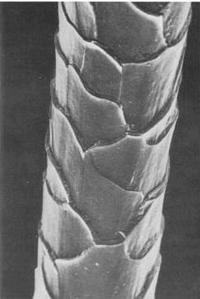
(Image from Technology in Australia, a photomicrograph of a wool fiber.)

(When I started writing this back at the beginning of August, daytime temperatures here were at or above 100F every day. In the last week we've had some rain and the resulting cloudy days have reduced temperatures to 'only' 90F or so. Believe me, that feels like relief!)


Bujiatang left a comment on "Wednesday Musette":


I was wondering if I could ask a bit of advice myself about commuting.


I wear cotton boxers and the weather in Minnesota has been a bit hot and muggy too.


do you suggest a different garment? A better fabric?


any advice is appreciated.


Do we really need cycling clothes for commuting? If your commute is short - no, you don't. But if you're planning to ride every day or your commute is more than a couple of miles, cycling clothes can make your saddle time more comfortable. These days there are more choices than the traditional jersey and shorts, but I wouldn't be caught dead in them. Strange, isn't it? I think nothing of wearing a jersey and shorts, but draw the line at those dorky capris. Go figure.


Here are a couple of links to other cycling clothing choices:


http://urbanvelo.org/spectrum-techwear/


http://commutebybike.com/2008/07/30/nema-jewel-thunder-bike-shorts-review/


Though he didn't say so explicitly, Buji hit squarely on 2 essential aspects of any high-performance clothing: garment design and fabric design. I've elaborated on them in the sections below.


Let me preface this by saying that long ago, I rode every day wearing cutoffs and jockey shorts. Maybe I had an advanced case of iron butt or those pain receptors weren't fully developed, but if I tried that now, I'd be off the bike for days. All those seams would act as tiny saw blades on my skin. In order to continue riding every day I need to be careful about preventing saddle sores. (See the saddle sore piece for more.)


My commute here in Oklahoma is 7 miles - roughly a half hour ride at my leisurely pace. Please remember that "Oklahoma" is an Indian word for "this place is only 2 miles from the sun!" Yesterday's homeward ride featured 102F. It was still 101F at 10PM and it was over 80F when I rode to work in the morning. Dancers may 'glow' but I sweat like a pig.


In all honesty, I'll admit that I've ridden around town on a Saturday morning wearing cargo shorts over jockeys. I wouldn't make a regular practice of it, however. Cargo shorts are wonderful when I'm running errands and visiting yard sales, but they're not a good choice for long distances or every day use. I've worn cycling shorts under cargo shorts a few times, and while it's convenient, I wouldn't want to wear them all day. It's a near-certain prescription for saddle sores. I've even tried riding to work using synthetic shorts under my work clothes (think 'tighty whities' with legs) but I don't like sitting in an air conditioned shop as the stuff slowly dries.


My usual practice is to wear boxer shorts, but on a bike saddle they form folds and creases that have the same effect as those seams in jockeys. Eventually they start cutting into my skin. Even worse, the 'dangly bits' sometimes get trapped between my leg and the saddle, leading to some strange gyrations as I try to get everything situated comfortably.


My son gave me some synthetic polo shirts for Father's Day this year. They wick just as a cycling jersey does, so I've given some thought to getting some baggy mountain bike shorts for occasional use.


(A word of advice is in order here. Don't wear gym shorts when cycling. They tend to get hooked over the nose of the saddle. When you stand up, they stay down. This can be somewhat upsetting, though there are certain people who find it perversely exciting. You know who you are.)


Over short distances, nearly any type of clothing will suffice for commuting, but as Buji has noted, there may be better alternatives than cotton.


Fabrics and sweat


Back in the old days, cycling clothes were made of light wool. Even now, some very nice and very spendy cycling clothes are made of wool. Wool fibers move moisture over their surfaces by capillary action if I recall right. Sweat evaporates from the outside and the fibers wick more away from the skin. All wicking fibers do this, not just wool. In the late 70s or early 80s, synthetics were developed that performed the same function.


Cotton doesn't wick. Anyone wearing a t-shirt on a hot day has seen wet patches on their shirt. A wicking synthetic doesn't exhibit these characteristics. Sweat dissipates throughout the material very quickly, leaving no wet spots. the cotton fibers swell up, and the saturated fabric doesn't permit air flow, so there's less evaporation from the skin underneath. I once had a jacket made of ventile cotton and it exhibited this effect very well. When wet, the fibers swelled and stiffened the fabric almost like heavy canvas.


Why is this important? In cold weather, exercising hard enough to produce sweat isn't bad in itself. There's something invigorating about working hard in the cold, in fact. But a problem arises if you have to stop for a flat tire, for instance. You're no longer working as hard so you're not producing as much heat. Meanwhile, sweat continues to evaporate, chilling the body even more. Hypothermia is called the killer of the unprepared for good reason.


Sweat is one way your body controls temperature. In summer, we're all accustomed to sweating copiously on long, hot rides. Cycling clothing wicks the sweat away, and as it evaporates, it cools the air right next to the skin. I could be wrong, but I think a cycling jersey offers a larger surface area for evaporation than the skin beneath it, adding to the cooling effect.


Garment design.


Co-worker: I'd ride a bike but I wouldn't wear them funny shorts.


Me: Given your looks, that's probably a wise decision.


I'm not writing about exotic prints, sublimated artwork, or custom embroidery. This is about the basic construction of cycling clothing.


Anyone interested in the history of bicycle racing can see that clothing construction hasn't changed substantially in half a century. Fabrics have changed radically in that time, but the basics of bike clothing are almost set in stone. Jerseys have 3 pockets across the back - except for track jerseys which have none - and there's a zipper down the front. Zipers have been growing longer every year it seems. Back in the 1960s and earlier, jerseys came with collars like polo shirts and sometimes included a front pocket up near the shoulder for cigarettes. They stayed dry up there.


Purpose-built cycling clothing is all about sweat management, long distance comfort, and drag reduction. Form fitting clothes like the traditional bike jersey and shorts reduce drag by reducing frontal area and reduced flapping. That saves some energy, though frankly it's probably miniscule. Without quantifying it, let's just say there's a noticeable difference between wearing my cycling jersey in warm weather and that big white parachute of an anorak when it's cold.


Cycling shorts are black so those of us who throw a chain or repair a tire have someplace to wipe our hands afterward. Black doesn't show the grease and dirt. See the saddle sore post for more about shorts, saddle sores and other stuff you may not really want to know.


I mentioned these synthetic polo shirts up above. They'd be suitable for a short ride if I had someplace to put my keys and wallet. Likewise, I have some wicking T-shirts at home that would be equally suitable. But that's one thing about bike commuting - maybe one of the most important things, actually - and that is the problem solving we do in order to ride back and forth to work. I can't claim that my solutions are universal. What works well for me may not work at all for you. We each find solutions that are sometimes unique to our situations.


Labels: , ,

Wednesday, May 07, 2008

Looking for the right tool...

We know that 'fear from the rear' is irrational and it drives much of the facilities advocacy. But today I'm not addressing the institutional problems of dealing with traffic engineers, bureaucrats, and planners. Instead, I'm looking at the reduction of irrational fear on an individual basis.

Most of us with long experience seldom fear riding in traffic, and when we meet someone wholly consumed by that irrational fear we may have difficulty understanding it. I know I do at times. Our first response is to say that the fear is unfounded or greatly exaggerated, but this does nothing to reduce it. We can offer facts and statistics, yet they're all ignored. That's the definition of 'irrational' - something that defies reason and logic.

Think of watching a horror movie in a theater, for example. Objectively, we know that it's nothing more than sound and flashing lights in a darkened room. Yet the fear it induces is real - at least until the house lights come up.

My industry used to offer Fear of Flying classes for potential customers. Again, we know that flying is a very safe means of transportation, but simply telling a fearful person that isn't sufficient. The company offered classes that gradually habituated these customers through a succession of experiences that eventually led to taking a flight. It worked on two levels, the rational and the emotional.

That emotional approach is one we should discuss. Our opposition has met with considerable success by using fear as a tool. Is there an equally powerful one we could use? (Of the seven deadly sins, I could only remember gluttony, sloth, and avarice, and they're not really suitable, though I'm well acquainted with the first two.) Demonstrating vehicular cycling techniques is a real eye-opener but it works best one-on-one. We need something with the emotional impact of 'fear from the rear' that will let us reach a broader audience. I suspect that if we can influence large groups of individual cyclists, the institutional problems offered by traffic engineers, bureaucrats, and planners will simply go away.

Labels: , ,

Sunday, March 30, 2008

Take the Lane (Revised)


Image from Bicycling is Better with an excellent discussion of shareable lanes.

(This based on my monthly column from the Red Dirt Pedalers "Wheel Issues"...Ed)

By Ed W. and Brian P.

One of the primary concepts in BikeEd is lane-positioning. A cyclist should always maintain a safe distance from the gutter pan or parked cars, a minimum of 3 to 4 feet. And motorists in Oklahoma are required to provide at least 3' passing distance when overtaking a cyclist. A little math tells us that if we add 3 feet from the gutter pan, 2 feet for the cyclist, and 3 feet for the minimum safe passing distance, we get 8 feet. Most cars are at least 6 feet wide. Therefore, a shareable lane can be no narrower than 14 feet. Keep in mind that in Oklahoma, lanes are rarely wider than 12 feet. That's where defensive lane-positioning comes in.


"Taking the lane" increases safety and visibility. Both new and experienced cyclists are often reluctant to try this. It seems counter-intuitive that by moving further to the left, one decreases the risk of collision, but when cyclists try the technique, they're astonished to discover how effective it is. Lane positioning communicates whether it's safe to pass or not. When a cyclist is in the middle of a narrow lane, he's telling drivers behind him that there isn't sufficient space to share the lane side-by-side, and that they'll have to yield to traffic in the adjacent lane before overtaking. When the cyclist moves further to the right, he's indicating it's safe to overtake. A cyclist should NEVER ride too far right (i.e., hugging the fog line, the curb, or even the gutter pan) because it invites motorists to 'sgueeze by' in the lane regardless of safety. On a 2-lane road, the passing motorist might be forced to choose between a head-on collision or running over a cyclist. In short, improper lane-position is a good way to get squeezed off the road.


Earlier today I read a comment by 'Siouxgeonz” on “Commute by Bike” about her introduction to lane positioning. (Her own blog is “Urbana-Champaign Bicycle Commute”.) Here's what she had to say:


I was reluctant to claim the lane at first, in a huge part because so many of the people who wrote to say it was the right thing to do seemed to emphasize “making a statement,” and I so much don’t want to make a statement that people can talk about in my eulogy...Now, I cringe whenever I hear somebody say “but I worry about the one who doesn’t see me” and hugs the line, because so many more people *don’t* see you when you’re doing that. It’s a perceptual thing…


I, too, learned to take my lane with a baptism in fire on a busy road...Two of us were riding and my friend noted that the drivers were buzzing by awfully closely… which (my silly verbal mind; it takes words to make anything happen) made me think “oh, yea! I’ve read that if we move out…” so we did.


Danged if suddenly the drivers didn’t get a whole lot better at giving us room! Instant education! And we weren’t dead center; just crossing into that “you’re in the car part” threshold.


We stopped for a bite to eat, and when we started riding again, the drivers forgot how to pass us again. Oops, make that we were too far to the right, because as soon as we nudged out again… the drivers got better. Amazing how educable they are! (Used by permission)


Some cyclists think that it's rude or arrogant to take the lane. Some think the practice antagonizes motorists unnecessarily. My response to that is simple. Safety always trumps convenience. Nothing in the law requires anyone on the road to do something they know is unsafe, and hugging the fog line is definitely not safe. Yes, overtaking motorists may have to slow down and wait until it's safe to pass. Taking the lane increases everyone's safety when a cyclist asserts his lane position. Stop caring about impeding traffic and realize that you have a right to use the road in safety and comfort the same as any other road user.

Labels: ,

Sunday, March 02, 2008

Cyclist = Terrorist?


(Image from teamspider.com)

I'm not a fan of Critical Mass since it involves riding illegally in too many cases. Granted, there are a few who ride legally, but the ones that get publicity are the most lawless. Welcome to the media world. But even I have to say that this one is so outrageous, so over the top, that it's mind-bending stupidity can give you a headache:


Sunday, March 2, 2008 Terrorists on Two Wheels.

Last Sunday morning, a 29-year-old Chicago man rode his bicycle through a busy intersection in my neighborhood, against the traffic light, and was struck and killed by an SUV.

Since the only person who died was the bicycle rider, it will seem very odd that I'm going to call him a terrorist. Stay with me on this.

"Terrorism" is defined as "the unlawful use or threatened use of force or violence by a person or an organized group against people or property with the intention of intimidating or coercing societies or governments, often for ideological or political reasons."

...Because kids do crazy things, most of the riders probably had only a vague understanding of the movement's ideological underpinnings, although the guy who died last week wasn't a kid, he was 29.

The ideology at work is a form of nihilist extremism. The only real difference between this and flying hijacked airplanes into buildings is one of degree. It comes from the same place. Now this extreme political movement has a new martyr.


There you have it, folks! All those lycra-clad, sweaty cyclists are terrorists. Put 'em on the next plane to Gitmo.

Labels: ,

Tuesday, February 19, 2008

Admit it! You've been tempted to try this...

Scandinavian Indians? Whodda thunk it? Here's a wonderfully goofy idea, one that would no doubt get you arrested here in car-obsessed America. Protest the environmental impact of ginormous SUVs by deflating their tires. Presumably, this would deflate the owner's ego as well as his, um, manliness. There's no denying that ownership of a hulking, over-powered, over-weight beast of a machine has a huge impact on manliness, unless it's lying there all limp and useless. The car, that is.

I love this last bit:
"The police are looking into the case as vandalism, although there is some dispute among legal experts as to whether the temporary inconvenience of having one's tyres deflated actually consitutes wilful damage of property."

There's a remote possibility that the Finnish Indians will make peace with the SUV-drivin' infidels. They could offer a gift of feathers, beads, and lutefisk. On second thought, this could be a long, bitter fight.

Excerpts follow, but the link will take you to the full article.


(LINK)

(Image from Militant Angeleno, August 2007)

Environmental activist group “Asphalt Indians” deflate tyres of SUVs


A campaign of emptying the tyres of sports utility vehicles in the name of protecting the climate, carried out by a group calling themselves "Indians of the Asphalt Jungle", is believed to have spread to Finland.

In the South-western city of Turku, after the weekend, the air has been let out of the tyres of at least three parked vehicles on Sirkkalankatu and in the Ylioppilaskylä student village.

A note was left on the windscreen of each of the targeted SUVs, saying "Your city SUV kills".
In the same note the target of the act of vandalism was consoled: "Do not take this personally, it is only your car that we do not like".


...Det. Sgt. Harri Savolainen of the criminal police says that "all four tyres of each of the vehicles have been emptied, but the tyres have not been slashed. That is not how they operate."
Savolainen believes that more similar attacks may still well be reported to the police through the Internet during the course of the week.


...The police are looking into the case as vandalism, although there is some dispute among legal experts as to whether the temporary inconvenience of having one's tyres deflated actually consitutes wilful damage of property. In any event, there may be claims for compensation in prospect against the perpetrators, for instance for the vehicle-owners' taxi and towtruck costs.

Labels:

Tuesday, February 05, 2008

Build it and....they don't come anyway...

The Miami Herald ran a story about the growing network of bicycle lanes that remain unused. Naturally, this is viewed as a monumental waste of money. Local cyclists avoid the worst of them. But the remarks from Leah Shahum, executive director of the San Francisco Bicycle Coalition, are particularly enlightening. She says it takes 10 years to build a cycling community that will regularly utilize those lanes. Ten years. If politicians or planners suggested that we build highways, water pipelines, or sewers based on the assumption that they'd be used ten years in the future, well, those good people would likely be looking for new jobs long before those years passed by.

If this argument were true, the ever-increasing amounts of public monies spent on bicycling facilities since 1990 should have produced a cycling utopia by now. Without going back over the statistics, I recall that the amount has increased by more than ten times, yet the number of cyclists remains relatively flat.

Somebody is making a boatload of money from these projects, but it surely isn't the bike industry or the local shops, and cyclists themselves seem to benefit the least.

Excerpts follow.


(LINK)
Mandated bicycle lanes are getting little use
RULES TO CREATE MORE BIKE LANES HAVE ENCOURAGED A GROWING NETWORK OF PATHS FOR CYCLISTS. BUT THAT DOESN'T MEAN THEY'RE BEING USED.

Posted on Sun, Feb. 03, 2008

BY DAVID SMILEY
dsmiley@MiamiHerald.com


A lone cyclist pedals east on one of the newly added bike lanes along Pines Boulevard between Hiatus Road and 108th Avenue in Pembroke Pines during an evening rush hour.
MARSHA HALPER / MIAMI HERALD STAFF

The morning commute on Pines Boulevard is a little less hectic for motorists these days.

Rush hour traffic often flows smoothly on the highway thanks to a fourth eastbound lane added during the past two years in the congested stretch between 136th Avenue and Douglas Road.

But the new bike lanes added during the same project are a different story: Mostly, they're empty.

...And although experts say bike lanes are the safest place for cyclists, Key Biscayne, North Miami and Hallandale Beach have all questioned whether cyclists will really ride next to speeding cars.

...''How do we view that area? Like the plague. We avoid that area at all costs,'' said Craig Sloan of the cycling group South Broward Wheelers.

...But while colored bike lanes and striped separators may make cyclists comfortable, they do little to stop accidents, said Dwight Kingsbury, assistant pedestrian and bicycle coordinator for the Florida DOT.

...Hallandale Beach Vice Mayor William Julian said from his experience, cities are better off saving their money than placing bike lanes on busy streets.

When Hallandale Beach added bike lanes to North Federal Highway in 2003, many said it was pointless, Julian included. His opinion hasn't changed.

But safety often comes in numbers and numbers come in time, said Leah Shahum, executive director of the San Francisco Bicycle Coalition.

San Francisco is widely recognized as a cycling-friendly community and was called one of the top 10 cycling cities by Bicycling Magazine last year. But Shahum said cycling took nearly a decade of consistent advocacy and bike lane construction to really catch on.

That's why it is so important to build bike lanes now, even when no one seems to use them, Kingsbury said.

''If you build the roadway without the bike lane, you've locked yourself in,'' he said.

And eventually, as in San Francisco, bike lanes will catch on when traffic becomes unbearable and widening roads becomes impossible, Shahum said.

Labels:

Monday, February 04, 2008

Texting while driving...

Monday he was arrested, on Tuesday he was tried
The jury found him guilty and the judge said “Ninety-nine”
Delia's gone, one more round and Delia's gone.

Delia” performed by Koerner, Ray, and Glover
MP3 file available

I stumbled over this earlier tonight while looking for something else.


(LINK)

Category: Motor Vehicle Accidents

Along with the ability to send text messages while driving comes the likelihood of more traffic accidents. Psychologists at the University of Utah say that texting behind the wheel is 50 percent more dangerous than talking on a cell phone while driving.

...There was a story reported on Wednesday on The Early Show relaying the clear message that the practice of texting while driving can cost lives - seems obvious enough. There are some horrible stories out there for example "On the day before Thanksgiving last year, high school senior Patrick Sims was driving less than a mile from his Denver home and texting a friend, when his girlfriend suddenly screamed. When Sims looked up, he was just inches from a cyclist in the bike lane." It was too late. Sims killed the 63-year-old grandfather and at the same time changed his life forever.

...As for Sims, he now talks to teens about his crash while texting and the life he took. He no longer has his license or cell phone. He is on probation and has served 10 days in jail.

........

Now let's be clear. Sims killed a man and he'll have to live with that forever. But his 'punishment' is 10 whole days in jail and probation. Could we expect a similar punishment if he'd run into another car and perhaps killed a child? Are cyclist's lives so little valued that a killer can apologize by saying "My bad!" and walk away?

If I ever have to kill somebody, I'll be sure to do it in Denver.


Now Curly's looking high, and Curly's looking low.
He shot poor Delia down, good people, with a big bore forty four.
She's all I've got, is gone.

Curly says to the judge, what may be my fine?
The judge says "Poor boy, you've got ninety nine."
She's all I've got, is gone.

You can call out your rubber tired taxis, your double-seated hacks.
They took poor Delia to the graveyard, people, and they failed to
bring her back.
She's all I've got, is gone.

"Delia"
Based on a version sung by David Bromberg.


Labels:

Monday, January 07, 2008

"Huffy vs. Hummer"


Here's something interesting, a week-long debate between Will Campbell and Randal O'Toole about cycling in Los Angeles.

Today, local blogger Will Campbell and Cato Institute senior fellow Randal O'Toole determine who bears responsibility for the road rage between cyclists and motorists. Later in the week, they'll debate public funding for bike lanes and paths, cycling activism and more.

LINK

Who's to blame for road rage? That's easy - stupid people - regardless of their transportation mode. Honestly, you can ride like a complete moron, ignoring stop signs, riding on sidewalks, etc, and you'll piss people off. On the other hand, you can ride as a lawful, vehicular cyclist, and you'll piss people off. Screw 'em. Don't let someone else's rising blood pressure cause a similar rise in yours. Smile, wave, and use some language that would make a sailor blush.

Labels: , ,

Thursday, December 27, 2007

Another idea for advocacy...


I signed up with NowPublic during the ice storm. It's a news/social networking site. This is fun because it combines the functions of a web forum with easily accessed links to news articles. Naturally, since I'm deeply involved in bicycling advocacy I want to see if NowPublic offers another venue for cycling advocacy and education.

One thing they offer is an automatic posting mechanism, where a post to NowPublic is automatically posted to a member's blog. For now, I won't enable that, so CycleDog will remain focused on cycling. That may change sometime in the future, but I'll let you know if I decide to go that route.

There's a search box that includes members names, so if you're interested in following what I've posted over there, just do a search for CycleDog. Yeah, I know, it's not very imaginative but at least it's consistent.

Labels: ,

Wednesday, October 24, 2007

ATTN: All Tulsa Bicyclists


(Image from Bike Friday)

By Paul Tay (LINK)

Sharon King Davis and Dewey Bartlett Jr., leaders of the "Complete Our Streets" panel established by Mayor Kathy Taylor and City Councilor Bill Martinson, invite all interested Tulsans to attend a Citizen Town Meeting on Monday, Oct. 29, from 5:00 to 6:30 p.m. in the Central Center at Centennial Park, 1028 E. Sixth St. (Sixth Street and Peoria Avenue).

The panel invites Tulsans to share their comments by either speaking to the group or submitting written comments. Those who want to speak will be asked to sign in before the meeting begins.

The Complete Our Streets panel is taking a comprehensive look at Tulsa's streets. This includes information gathering, questioning of information, and decision making for recommendations to be submitted by December 4 to the Mayor and City Council.

The panel will focus on three aspects of Tulsa's streets: contracting, smart urban design and financing. A committee has been assigned to study each of these three areas. For further information, you may contact the City of Tulsa Mayor's Action Center at 596-2100.

Thanks, Paul!


Labels: , , , , ,

Wednesday, October 10, 2007

What next?

The voters of Tulsa County decided they really didn't need to increase sales taxes to fund a river park system. I've written about it previously, and I did not support the tax increase for reasons given here.

But as that title above asks, what comes next? Many voters are concerned about the sad condition of our local streets. Many of our bridges are in dire need of repair. But I don't live in the city of Tulsa. I'm a suburbanite. Still, I have to travel in Tulsa, so the streets and roads are part of my life too.

If I recall right, the cost estimate on doing the maintenance and construction would be four times that of the late river project, and that totaled $285 million. Where will the money come from?

Honestly, I could see Tulsa voting in a commuter tax on us suburb dwellers. These kinds of taxes are usually popular because they aren't levied on residents. Instead, out-of-towners, who can't vote in the election, are taxed to support city services. If it weren't an onerous tax, I wouldn't mind paying it. But I'd certainly expect to see good roads in return for my money.

Yes, I'm probably a hopeless dreamer.

Good roads benefit everyone, motorists and cyclists alike. Signalized intersections that reliably detect bicycle riders should be the norm, not a rarity. And while Tulsa and surrounding communities do have signals that trip for cyclists, far too many signals do not operate as they are designed to. And when you consider that some signals in downtown Tulsa are nearly 80 years old, well past their design life, and that a 'simple' signalized intersection costs about $100K dollars, you can see that tax money can be stretched thin in a hurry.

So, are there other way to fund streets? I know there must be, but I'm not versed in public finance. Any suggestions?

As my crew chief is fond of saying, "There ain't any one of us as smart as the rest of us put together!"

Labels: ,

Sunday, September 23, 2007

A comment on an older post...


(Image from David Byrne)


In a response to - Is Tulsa Bicycle Friendly? - which appeared here on May 15th, Natalie wrote the following:

Bikes belong on the road... Pedestrians have the right of way, but unfortunately, bikers forget that fact. Hence, kick them the hell off of the paths where they don't belong anyway. My kids are terrified of bikes because of the way the "racers" force everyone to move out of their way on the paths. New ordinance: No bikes on paths... PERIOD! Pedestrians are tired of being harassed!


(Image from Fyxomatosis)


Bikes belong on the road. I couldn't agree more. But as for prohibiting them from using paths, I have to disagree. Far too many cyclists are terrified of riding on the road. They prefer the presumed safety of a separated side path, and in some municipalities, they are legally obligated to use such a sidepath when it is adjacent to the road. Tulsa did away with this restriction some time ago. Good riddance.

Sidepaths provide the illusion of safety, but as pedestrians and cyclists mix, the probability of a crash increases. That's why anyone with an interest in going fast, training at high speed,or riding in a pack, will avoid riding on a multi-use path. One of the most popular in Tulsa is the River Park trail system which isn't really suitable for speed due to its many curves and elevation changes. It's difficult to judge which side of the trail an oncoming cyclist or pedestrian is on, and the gravel running track on one side makes that judgment even more problematic. Furthermore, the present trail is actually too narrow by current design standards.

That will change soon when the River Park Authority constructs a new trail parallel to the existing one. Users will be segregated - cyclists on one trail and pedestrians on the other. Will this eliminate conflicts? No, because the clueless will be with us always. Peds will walk on the bike trail and cyclists will ride on the pedestrian one. Unless we can find a means of performing some fundamental change on human nature, the conflicts will continue.

I attended a meeting with the River Park folks some years ago. The biggest area of conflict was near the Full Moon Cafe, because it had the greatest usage. Their temporary solution was to paint lines on the trail and put up some speed limit signs.

Even my son, who was about thirteen at the time, noted that the River Trail isn't a place to go fast. And this from a kid who had only two speeds - stopped and full speed ahead. Why is it difficult for an adult to comprehend?

I get very nervous when overtaking pedestrians, especially children. They can change speed or direction in a single step. Skaters, with their side-to-side motion, can be difficult to pass too. And I think there should be a special place in Hell reserved for those people walking their dogs on 25-foot retractable leashes. The dogs get a pass. The owners, no.

Now, I may get all maudlin for a moment. Natalie would gladly prohibit cyclists from pedestrian trails. Motorists would gladly prohibit us from the public roads. Hmm...I'm feeling distinctly unwanted. If I weren't such a steely-eyed macho kinda guy, I may shed a tear or two and get all weepy. I hate that. So let's re-visit that first statement - bikes belong on the road.

Bicyclists really do belong on the road. We have just as much right as anyone else on the public way. Note that I said just as much, as in equal, not more and not less. For that matter, since a sidepath is also a public way, we have an equal right to use it, provided we share it safely with other trail users.


Labels: ,

Tuesday, August 07, 2007

Tuesday Musette

Just two items today.

Football: Threat or Menace?

I fully expect to hear something like this on a television station here in Oklahoma one day:

Nuclear war has broken out in Asia, but first here's our coverage of today's OU football game!”

Football is the new paganism with its own pantheon of gods, demi-gods, saints, demons, imps, and a succubus or two. In case anyone is wondering, I'm just a bit testy this morning and it's all because of football.

Number One Son is a football fanatic. He lives, eats, breathes, and sleeps football. If he's here alone, the television is tuned to the NFL all-football-all-the-time network. He may not be capable of spelling common English words, but he knows obscure football statistics and trivia. I think he's insane.

Of course, he plays football in school, and his first day of practice was yesterday. The football demons decided that it was necessary to have a 'midnight' practice. Yes, you read that right. They practiced until well after midnight. Jordan called at 1AM saying he was ready to come home. Mary shook me awake and I was off.

Traffic is very light at one in the morning. I arrived at the field house in a few minutes, spotted Jordan waiting, and promptly made the run back to the house. Along the way, we spotted a cyclist wobbling along 86th Street, wandering from lane to lane well ahead of us. I slowed down, thinking he might be drunk, but after a few stylish zig-zags, he made a left into a neighborhood street. Need I mention that he had reflectors but no lights or helmet?

We got home and I fell back into bed only to awaken at 3AM with my sinuses dumping into my throat. I hacked and wheezed. A hot cup of tea (Red Zinger, no less!) helped me breathe properly once again, and I dozed off.

The alarm went off at 5AM, as usual, and I swung my legs out of bed feeling bad again. No ride for me today. I drove to work instead. And it's just as well that I did. I was so tired that I fell asleep at my workbench once or twice.


The Rest of the News...

This is local content. The Owasso Public Works Department unveiled engineering plans for 129th East Avenue. The street will be widened to 5 lanes running north from 76th Street to about half a mile south of 96th Street where it will join an existing 5 lane section. Construction is expected to begin in September. While the road work is underway, two lanes will always be open as will access to the neighborhood streets. The plan calls for a signalized intersection at the Sixth Grade Center and an improved signal between the high school and mid-high. The schedule calls for a 450 day duration to the construction and an additional 60 days for cleanup and landscaping.

(Link to Owasso Reporter)

For cyclists, this means riding 129th will be a definite improvement after the project is completed. The street is an average 2 lane now, and it can be difficult for motorists to pass. I've had more problems along that street than on any other around here. This is very welcome news.

Labels: ,

Another annoyed motorist rant...

It's one of those "I ride a bicycle too, but..." kind of posts. An obviously exasperated motorist is put out that many cyclists ignore the rules of the road. Excerpts follow:

Same Road, Same Rights, not the Same Rules

The mantra of bicyclists who ride in busy areas seems to be same roads, same rules, same rights. I personally loved riding my bicycle to work for the three years it was truly amenable.

...But...I am sick of bicyclists who want their cake and plan on eating it too. For goodness sake! Same rules. That what YOU keep telling me. The hardcore bicycle brigade around here wants me to ignore a third of THEIR message. I am sick of watching near misses as the rule about stopping at a red light is ignored. One way streets? Those rules do not seem to apply, either.

...With every near miss you make me angrier that my tax dollars are funding enhancing an activity for those above the law. (ie bike paths and the such)Like smokers, some leadership by example is necessary. C'mon y'all. If part of your platform is same rules, start abiding that. I know there are responsible cyclists out there, there just has to be. Will you guys please get out there and show the rest how it is done?

...C'mon y'all, teach these yahoos same roads, same rules, same rights. Put some emphasis on rules. Or just add another R. Same responsibility. I just want what you all want.Make cyclists live by their mantra.

Madam, I feel your pain. I can't count the times I've wondered why I continue to support all those motorists with my own hard-earned tax money - money that goes overwhelmingly to build infrastructure that reinforces the dominance of motor vehicles as a transportation mode and increases our dependence on foreign oil, pollutes our air, yadda yadda yadda.

Look, let's just cut to the chase. It's ridiculous to suggest that the actions of any individual reflect on those of his peer group. It's a false generalization. If one cyclist runs a red light, all cyclists are lawbreaking fools. It's the same as saying that one speeding motorist reflects badly on all motorists. You would likely object to being characterized as a road-going menace because I encountered another motorist doing something stupidly dangerous on my daily commute, so I won't attempt to tar you with that particularly wide brush. Please, if at all possible, return the favor.

I'm an instructor with the League of American Bicyclists. We teach people how to ride safely and comfortably in traffic, and no, we don't teach them to ignore stop signs or red lights, and we never condone wrong-way riding. Chances are, you've met us 'vehicular cyclists' on the road and you didn't give us much thought, just like you don't think about the 99% of motorists who operate safely and competently on our roads. It's the fools and nutcases who get our attention, regardless of their transportation mode. The rest just slip under our radar.

But if you really want to influence people in a positive way, ride your bike. Ride it legally, observing all relevant cycling laws. Learn when it's best to share the lane and when it's better to take it for your own safety. Take a Road1 course from the League and learn to be a confident, skilled cyclist. We can change our cycling culture, but we'll do it one cyclist at a time. Trust me, when passing motorists see the same cyclist everyday on their commute, a few of them will think, "Hey! I could be doing that!"

It's all part of our plan for global domination, but failing that, I'll take a bunch of skillful cyclists on our roads instead.


Labels:

Wednesday, August 01, 2007

Ban or restrict cycling?

Brian Potter, a good friend and local bicycling advocate, asked on the Oklahoma mailing list if we thought bicycling should be banned or restricted. This was in conjunction with the statement that local law often varies from state law here in Oklahoma, and most municipalities still have the obsolete "as far right as practicable" language. What follows is my response:

Cycling is already effectively banned on many of our roadways, Brian. When a rider says, "There's too much traffic" or "It's too dangerous" or "all those motorists are out to kill me" he's essentially banned himself from the road. When he rides on the sidewalk or hugs the right-hand fog line thinking that by doing so he's being safe or more courteous, he's accepted second-class status on our streets. When he says he can't get from A to B because there are no bikelanes, he's bought into our societal view of cyclists as inferior road users, with inferior rights and inferior expectations.

And most motorists, city planners, and police are perfectly happy that these cyclists accept their subservient position. It makes driving easier when cyclists get the hell out of the way. Even better, when the city provides a debris-filled substandard bike lane and forces cyclists to use it instead of the roadway, they get a two-fer. First, it gets bicycle riders off the roadway, and second it discourages them from using a bicycle more often.

But what's worse is when well-meaning but uninformed cyclists insist that limited monies be spent constructing poorly designed facilities, apparently believing that ANY project thrown our way is good. This reduces the pitifully small amount that could be spent on bicycle education - you know - the basic knowledge and skill that a cyclist needs when the bikeway ends - and that reduction allows for the construction of more half-baked projects, further reducing the numbers of those pesky cyclists.

It's a plot, I tell ya!

Labels: ,