Tuesday, November 08, 2011

Op-ed: The Oklahoma Bike Summit

Here's what I wrote yesterday about the Oklahoma Bike Summit:

Andy Clarke, president of the League of American Bicyclists, addressed the meeting after lunch. Clarke is an engaging speaker and covered a wide range of bicycling-related topics. He spoke of Copenhagen, where the average number of commuting cyclists would be considered a huge turnout for any North American tour. Clarke brought out the 'safety in numbers' argument, which seems to indicate that increasing numbers of bicyclists do not lead to a proportional increase in bicycle crashes. He said, “We need complete systems, not just infrastructure.” That includes promotion, marketing, and education.

Clarke was concerned over the possible loss of transportation enhancement funds due to the political wrangling in Washington. He strongly advised those present to contact their senators and congressmen. “It's all about showing up,” he said, referring to the political adage that policy is set by those who make an effort to attend meetings.

When asked about the Reed Bates case in which a cyclist was arrested and jailed for riding on a public roadway, Clarke said, “His case was a disaster waiting to happen. It would not have set a precedent. He was not a sympathetic character.” Clarke defended the League's record regarding challenges to cyclist's rights by saying, “We have been involved in a number of such cases over the last several years.”


There was much more, of course, and most of it was omitted for the sake of brevity. I'll say this for Clarke, he's an excellent speaker. He pushed all the usual buttons: Copenhagen, safety in numbers, 'normal' cyclists, trip distances, bike sharing, and a statistic saying that a single traffic fatality has a $6 million cost. Clarke is concerned over the possible loss of transportation enhancement funds in the coming fiscal year, and like other cycling insiders, he seems to be concerned about demographics.

Demographics cut to the heart of cycling advocacy. Bikes Belong has a demographics report on the website detailing many items of interest to cyclists. The bar graph showing the age distribution of survey respondents caught my eye. It indicates that the average age of an 'enthusiast' cyclist is in the mid-forties. Now, please remember that this is a self-selected survey, so the results should not be regarded as representative of the entire population of cyclists, but the last census put the median age at about 37, well under the supposed average age of cyclists. Experienced bike riders are an aging population, and since they're the League's membership, the clock is ticking on an eventual downturn.

In the 1990s, the Amateur Radio Relay League surveyed their members and found that the average age was in the mid-fifties. ARRL pushed for some changes, eliminating Morse code entirely, simplifying the license structure, and updating the technical aspects of their testing to more modern standards in an effort to attract a younger crowd. Should LAB consider similar changes, and if so, what changes should they make?

There are huge, untapped demographics that go largely unnoticed by most of organized cycling; the poor who use bikes for basic transportation, and those young bike riders in their teens and twenties who comprise fully half of all bicyclists. Among the experienced cyclists, roughly half ride for transportation if only occasionally, but the bulk of their rides are for fitness and recreation.

Grist had this to say:“Contrary to popular convention, the biggest share of bicyclists isn't yuppies, it's low income people. In fact, the lowest-earning quarter of Americans make nearly one-third of all bike trips.

Clarke obliquely touched on this when he said that he wanted cyclists to be 'normal' in the sense that they don't need to ride in dedicated cycling clothing for short trips. Meanwhile, those low income cyclists are already riding – to work and back – in ordinary street clothes. They don't have much disposable income, meaning that they won't consider spending money to join an organization unless it provides some tangible benefits. At present, LAB doesn't do that for existing members, so enormous changes would be demanded if the organization wants to tap this demographic.

Seventy percent of the respondents to Bikes Belong were happy or somewhat happy with existing facilities. The message is that the loss of transportation enhancement money would not have a great impact for them. It would seem natural that LAB would pivot on this and push their education program because it teaches cyclists how to use all streets safely, not just those with bike lanes. Education has been the red-headed step child at LAB for quite some time. It would be a heartening change to see it given greater emphasis.


Labels: , ,

Monday, November 07, 2011

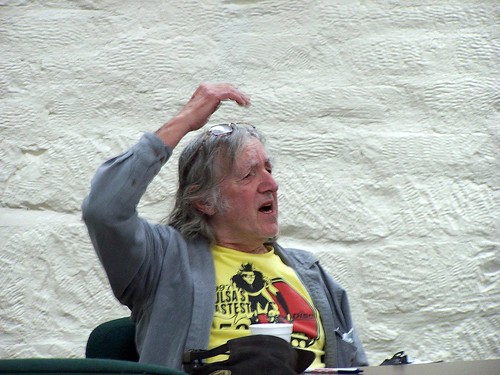
Andy Clarke addressing the summit.

Oklahoma had its first bike summit over the weekend at the Chesapeake Boathouse in Oklahoma City. The Oklahoma Bicycling Coalition organized the event.


Lon Haldeman, famed ultra-cyclist and the operator of the PacTours bicycle touring company, talked on the history and allure of historic Route 66 through Oklahoma. This state has more remaining miles of the original road alignments than any other state, drawing tourists from all over the world. This historic highway had tourist amenities roughly 20 miles apart along its length, a perfect distance for bicycle tourists. Additionally, other states have concluded that bicycling tourists spend as much as their motoring counterparts, yet they spend in a more confined area.


When asked, “What can communities do to attract cyclists?” Haldeman replied that two things help greatly: roadways free of drainage grates that cause diversion falls, and adequate signage to inform and direct cyclists along city streets. He mentioned that much of the signage for both historic Route 66 and cyclists has been vandalized or removed, and suggested pavement markings as an alternative.


Ginny Sullivan talked about the Adventure Cycling Association whose 44,000 members make it the largest national cycling organization. She said that the goal is to inspire bike travel. With hundreds of volunteers, maps, extensive social media contacts, and a website, Adventure Cycling is trying to attract a younger crowd as the present demographic is aging. One new idea involves bike overnights, simple out and back bike tours that begin and end at home. Sullivan spoke extensively on the economic impact of bike touring, both from the standpoint of a touring cyclist and those communities hoping to attract tourism dollars. Bicycle tourists spend $100 per day on average, and they do so in a relatively small area.


Joy Hancock, the new director of Oklahoma's Freewheel, shared her thoughts about the annual cross-state tour. As yet, no economic study has been done on the tour's impact in the small towns where it makes overnight stops, but she believes it contributes about $25,000 in each community. The first seminar that will detail the 2012 route will be held January 10th.


Sandy Pantlik, director of travel promotion for the Oklahoma Tourism Department, talked about the Scenic Byways program, bike trails, and the travelok.com website. She noted that the state had bicycling maps at one time, but they are no longer in print. Oklahoma attracts $6.2 billion in tourism spending each year, and bicycling would add to that total. Like Lon Haldeman, she also spoke on the state's close ties with Route 66 and its history. Oklahoma plans to develop Route 66 as a bicycle route, but as yet funding is not available.


The Oklahoma Bicycle Coalition conducted a brief meeting over the lunch break, introducing a bylaw change would allow for new initiatives to be proposed by two or more members and voted on in any meeting. The bylaw change passed unanimously.


Andy Clarke, president of the League of American Bicyclists, addressed the meeting after lunch. Clarke is an engaging speaker and covered a wide range of bicycling-related topics. He spoke of Copenhagen, where the average number of commuting cyclists would be considered a huge turnout for any North American tour. Clarke brought out the 'safety in numbers' argument, which seems to indicate that increasing numbers of bicyclists do not lead to a proportional increase in bicycle crashes. He said, “We need complete systems, not just infrastructure.” That includes promotion, marketing, and education.


Clarke was concerned over the possible loss of transportation enhancement funds due to the political wrangling in Washington. He strongly advised those present to contact their senators and congressmen. “It's all about showing up,” he said, referring to the political adage that policy is set by those who make an effort to attend meetings.


When asked about the Reed Bates case in which a cyclist was arrested and jailed for riding on a public roadway, Clarke said, “His case was a disaster waiting to happen. It would not have set a precedent. He was not a sympathetic character.” Clarke defended the League's record regarding challenges to cyclist's rights by saying, “We have been involved in a number of such cases over the last several years.”


This is the text that appears on the Examiner, along with that photo up at the top. Believe me, that huge, back-lit window gave me fits. It overpowered the anti-reflective coatings in both my Olympus lenses, leading to numerous ghost images. I took some photos with the 50 year old Konica Auto S2 also, and it will be interesting to see how they look.

This piece is straight reportage. I'll write an op-ed with my views on the summit in the next couple of days.


Labels: , ,

Wednesday, October 28, 2009

OBC Annual Meeting

From the OBC website:

OBC Annual Meeting

In Meetings and Discussions - Agendas

Annual Meeting of the Oklahoma Bicycling Coalition2 PM, November 8, 2009 Parks and Recreation 315 E 9th Stillwater, OKPre-meeting bike ride 11 AM - Cooper's Bicycle Center, 220 S Main, Stillwater

Labels:

Tuesday, March 04, 2008

Oklahoma Bicycling Coalition Meeting

2008 OBC President Chuck Davis of Tulsa
(CycleDog Image)

Oklahoma Bicycling Coalition

SPECIAL BOARD MEETING

2MAR2008

(New officers and directors list from OKBIKE.ORG)


Written by Pete Kramer

Monday, March 03, 2008

New 2008 Officers and Board of Directors were elected at the Special Meeting of the Board and Members held in Stillwater, Oklahoma.

The new officers are:

Chuck Davis, Tulsa, President

Richard Hall, Tulsa, President Elect

Mary Cash, Stillwater, Secretary & Past President

Pete Kramer, Oklahoma City, Treasurer


The new Directors are:

Don Norvelle, Stillwater, Education Director

Shawn Gibson, Stillwater, 405 Region Director

Sterling J Hale, Stillwater, 580 Region Director

Christina L Birch, Tulsa, 918 Region Director

Jim Beach, Tulsa, Web Director

Susan Walker, Stillwater, Membership Director

Vacant, Legislative Director

...........


In his address to the assembly, incoming OBC president Chuck Davis said that the key to expanding the organization is membership involvement. To that end, he wants the present Yahoo mailing list to be the property of the coalition. He wants to publish the membership list as a means to enhance participation. The membership is crucial if the coalition is to survive.


Let me say this about memberships. All groups include a small number of people who actually do the work. The rest of the group contribute dues to support that smaller group's efforts. In effect, their dues reflect their agreement with the organization's stated goals and its actions toward achieving those goals. When those interests diverge and the officers no longer reflect the goals of the members, those disaffected members simply walk away. They vote with their feet.


I did not renew my OBC membership this year.


There was a possibility of taking a position on the board, but given its composition, I'm greatly relieved that I did not give it serious consideration. I could not work with some of the people listed above under any circumstances, let alone the climate of mistrust and acrimony that's prevailed over the last several months. I've done volunteer work for a number of organizations, work that at times was unpleasant, but none of them caused as much personal aggravation as this one.


In one way, I hope that the OBC can be rescued and that the present board will pull it back from the brink of destruction. Yet when I consider that several of the officers contributed to that downward spiral, in reality I see little hope. Maybe I'll be proved wrong about this. If so, I'll gladly re-up my membership. On the other hand, if the present slate of officers puts the coalition into a long tailspin, I'll probably be there to help rebuild it after the crash-and-burn.


Labels: , ,

Saturday, August 25, 2007

The doldrums...

These are the dog days of August, days that are too stinkin' hot to do much outside, other than ride back and forth to work. Even then, with the heat index above 110F, I don't want to ride my bike. The alternative would be to write more, but that's been a struggle recently, too.

I'm stuck in the doldrums. Writing has been difficult because I lack good ideas. I still have a passion for it, and that's something that has been a constant since I started CycleDog. I hesitate to post about other bicycling-related news items, because all of us can get them from so many sources. It's hard to do something original, and I really don't want to copy someone else. If you want late-breaking news, I urge you to read Cycle-licious, Masiguy, or BRAIN.

The worrisome part of all this is that I've lost my enthusiasm for bicycling advocacy. I've considered giving up my LCI certification also. The lack of real progress at the state and local level has me very frustrated and even angry at times. Realistically, I know that change takes time, so perhaps the frustration is more due to impatience - and everyone who knows me will attest to my lack of patience.

Still, it's annoying to have the same arguments over and over with the paint-n-pavers. They're not interested in reality-based arguments, or as one of my co-workers said so well, "Facts - however interesting - are irrelevant!"

I'm disheartened by the apparent abandonment of the bicycling subcommittee at INCOG. I hoped we could get some input on projects that impact area cyclists, and improve on them before they were quite literally cast in concrete.

I've all but given up on the Oklahoma Bicycling Coalition. OBC spent a lot of time and effort pushing the Share the Road tag, but I have doubts that it was a good effort, an effort that actually benefited Oklahoma cyclists. It was a good PR move, though. Since then, the OBC has managed to get some laws passed that actually work for cyclists, so again, maybe I'm feeling frustration from impatience.

Finally, and this is probably one thing that weighs heavily on me, I just haven't thought of anything funny for far too long. I enjoy writing comedy and I miss it when it's gone. There's no way to force it, so again, I end up frustrated. Maybe this is writer's block. Maybe I need more caffeine. Maybe I need more sleep. One thing's certain - I won't look for inspiration in a bottle of booze. I've been to the brink of that alcoholic precipice once and I will not go there again.

In a few weeks, the wind will switch around to the north. Temperatures will drop and with a little luck, we'll get some rain. Bear with me a while, and let's hope the weather changes for CycleDog too.

Labels: , , , , ,

Wednesday, August 01, 2007

Ban or restrict cycling?

Brian Potter, a good friend and local bicycling advocate, asked on the Oklahoma mailing list if we thought bicycling should be banned or restricted. This was in conjunction with the statement that local law often varies from state law here in Oklahoma, and most municipalities still have the obsolete "as far right as practicable" language. What follows is my response:

Cycling is already effectively banned on many of our roadways, Brian. When a rider says, "There's too much traffic" or "It's too dangerous" or "all those motorists are out to kill me" he's essentially banned himself from the road. When he rides on the sidewalk or hugs the right-hand fog line thinking that by doing so he's being safe or more courteous, he's accepted second-class status on our streets. When he says he can't get from A to B because there are no bikelanes, he's bought into our societal view of cyclists as inferior road users, with inferior rights and inferior expectations.

And most motorists, city planners, and police are perfectly happy that these cyclists accept their subservient position. It makes driving easier when cyclists get the hell out of the way. Even better, when the city provides a debris-filled substandard bike lane and forces cyclists to use it instead of the roadway, they get a two-fer. First, it gets bicycle riders off the roadway, and second it discourages them from using a bicycle more often.

But what's worse is when well-meaning but uninformed cyclists insist that limited monies be spent constructing poorly designed facilities, apparently believing that ANY project thrown our way is good. This reduces the pitifully small amount that could be spent on bicycle education - you know - the basic knowledge and skill that a cyclist needs when the bikeway ends - and that reduction allows for the construction of more half-baked projects, further reducing the numbers of those pesky cyclists.

It's a plot, I tell ya!

Labels: ,