Tuesday, June 08, 2010

Floyd Landis hires Lemond's attorney


This story from AFP (LINK) says that Floyd Landis has hired Greg Lemond's lawyer in case he faces a criminal case or a defamation law suit. Previously, I supported his fight against what I believed was a badly flawed case brought by the French anti-doping agency. As it turns out, I was wrong. Landis lied about using performance enhancing drugs. He lied right up through the Court for Arbitration in Sports. He continued to lie after the court ruled against him.

But we're supposed to believe him now that he's accusing others of similar cheating.

One question to ask is "who benefits?" Landis no longer has a team. It's extremely unlikely that anyone in professional bicycle racing will hire him, so his career is over.

I'm sorry that I supported his fight. I'm sorry that I believed he had a valid case against the French. But I will not be sorry for this - you've lied and cheated, Floyd, demonstrating to the world that your words mean nothing. You're facing an uphill battle because from now on, you'll be regarded as a liar first. Whatever tumbles from your mouth will not be believed. It will have no credibility unless or until you have proof for your allegations.

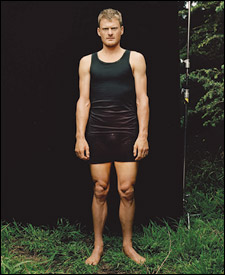
(By the way, I think the guy on the left is Keith Richards. Yes, there really is a guy over there! You didn't see him? I wonder why?)

Labels: ,

Monday, February 15, 2010

Floyd Landis....hacker?

The story is available on hundreds of sites by now. A French judge issued an arrest warrant - apparently only valid in France - for one Floyd Landis. Pierre Bordry, president of the French anti-doping agency, said Landis is wanted for illegally hacking into the files of an anti-doping laboratory while preparing for his defense on doping charges.

All this happened in 2007. They're just getting around to bringing charges now? Why is there a whiff of over-ripe cheese about this?

Landis was found guilty of doping. He appealed and lost. He cannot find a spot on a professional team despite having served his suspension. The French really seem to be vindictive over this whole affair since the basis for the warrant was a trace to the IP address of Landis' former coach, Arnie Baker. Unless there's much more they're not revealing, the information connecting this to Landis is sketchy.

But here's a thought - somewhere in France there's undoubtedly been some computer hacking during the Tour. And that pesky American, Lance Armstrong, has been in the country when it happened. It's very possible that Armstrong, as a secret member of an American cabal out to discredit French cycling, culture, haute cuisine, and their execrable cars, hacked into all those computers while hiding in plain sight within the pro peleton. It's only a little more far-fetched than the charges against Landis.

Labels: , , ,

Monday, December 17, 2007

News of Landis Appeal...


I know, I know. Some of you are sick to death of cycling and doping, so I'll keep this very short. If you remember the hearing Floyd Landis had last summer, you'll recall that despite the shortcomings of the French testing lab, they still found Floyd guilty. Then the panel went on to say that if these sloppy procedures weren't corrected, someday, somehow, someone would have to be presumed innocent.

Well, it's happened. USADA had its first ever loss before the Court of Arbitration for Sport in a case involving sloppy lab work. Sound familiar? It's the same argument that Landis is making.

Now, I promised to keep this short, so if you're interested just follow the link...

(LINK)

Labels: , , ,

Friday, September 21, 2007

My thoughts on the Landis case...

OK, everyone knows the Landis decision has been released. According to the panel, he was guilty of doping during the 2006 Tour de France. I wrote some time ago that I believed they'd find him guilty. This is not an I-told-you-so because I was hoping to be proved wrong. The lab committed grave errors and the panel recognized that. But I won't cover the same ground Radio Freddy did in Belgium Knee Warmers. Please read his post.

Anyone who's seen a police procedural like 'Law and Order' or 'CSI' knows that the standards of evidence in a criminal prosecution are quite strict. In the Landis case, the standards were much less stringent. In fact, had he been tried in a court of law, the case would most likely have been dismissed.

And, that, ladies and gentlemen, is what I'm proposing. The testing standards and chain of custody should be as strict as those in any court of law, if only to protect the integrity of the testing process, the defendant's rights, and our wavering faith in the anti-doping process. And to enforce that high standard, any athlete should have recourse to the court system in any doping controversy. If the anti-doping agencies have the power to ruin an athlete's reputation and destroy him financially, that athlete should have the right to bring charges against the agency, in effect, forcing them to act within the law. WADA has quasi-legal authority now because in order to participate in his sport, a professional athlete must submit to their testing regimen. The balance of power is too heavily weighted to the prosecution side.

Labels: , , ,

Sunday, December 10, 2006

Athlete's Unbeatable Foe

Here's an interesting story from the LA Times about the fundamental unfairness of the World Anti-Doping Agency. Yes, there are several anecdotes regarding top athletes, including Floyd Landis. But Dick Pound's overbearing ego is readily apparent too. When WADA is the sole judge, jury, and prosecutor in a doping case, it's absolutely contrary to any sense of fair play, particularly when an accused and convicted athlete has no recourse to our court system..........Ed

Excerpts follow:


Anti-doping authorities serve as prosecutor, judge and jury. The innocent often pay a high price.
By Michael A. Hiltzik, Times Staff Writer
December 10, 2006

Strict policy, or flawed system?


The worldwide sports anti-doping program, created to fight performanceenhancing drug use in international athletics, imposes severe punishments for accidental or technical infractions, relies at times on disputed scientific evidence and resists outside scrutiny, a Times investigation has found.

Elite athletes have been barred from the Olympics, forced to relinquish medals, titles or prize money and confronted with potentially career-ending suspensions after testing positive for a banned substance at such low concentrations it could have no detectable effect on performance, records show.

They have been sanctioned for steroid abuse after taking legal vitamins or nutritional supplements contaminated with trace amounts of the prohibited compounds. In some cases, the tainted supplements had been provided by trusted coaches or trainers.

The findings emerge from a Times examination of more than 250 anti-doping cases involving runners, cyclists, skiers, tennis players and competitors in dozens of other sports from around the world.


...Stringent anti-doping measures have become a fact of life for the thousands of athletes participating in national and international events since the creation of the World Anti-Doping Agency, or WADA, at an international sports conference in 1999. WADA's founding was prompted by a rash of doping scandals threatening the credibility of global sports.

What has evolved to protect competitive purity since then is a closed, quasi-judicial system without American-style checks and balances. Anti-doping authorities act as prosecutors, judge and jury, enforcing rules that they have written, punishing violations based on sometimes questionable scientific tests that they develop and certify themselves, while barring virtually all outside appeals or challenges.


...A test sample is typically divided into two vials, labeled "A" and "B." The "A" sample is the first to be tested. If it comes up positive for a banned substance, the athlete may demand a confirmation test of the "B" sample. If that is also positive, the code allows the agency to declare the athlete in violation of doping rules and impose a penalty ranging from a public warning to a lifetime ban. Generally, the athlete also is disqualified from the event at which the violation allegedly occurred.

An accused athlete's only recourse in the face of a doping charge is arbitration, under rules of evidence dictated by WADA and designed to give the authorities the benefit of all doubt.

In many countries, including the United States, athletes have no right to appeal an adverse arbitration ruling to the courts. In the vast majority of cases, including every case heard in the U.S., the arbitrators have upheld the violation.

Tests for banned substances may be performed only at one of the 34 labs around the world accredited by WADA. Athletes are not permitted to have their samples tested at any lab outside the agency's system. The rules also prohibit WADA labs from doing any tests in defense of an accused athlete.

WADA Chairman Richard W. Pound, 64, a Montreal lawyer, argues that the program must be so stringent and uncompromising to be effective against doping, which he calls "the biggest threat to sports."


"The less discretion there is in the finding of a doping offense, the better it is," he told The Times in an interview.

Pound, a former competitive swimmer who finished just out of medal contention at the 1960 Summer Olympics in Rome, dismissed the notion that a significant number of doping cases are accidental or inadvertent; WADA policy states that every athlete is responsible for everything he or she ingests or applies to the body. In the case of adulterated supplements, he said, "If you didn't know what was in there, it's your own damn fault." In the rare cases that an athlete can be proved truly faultless, he added, the system is flexible enough to temper its penalties.

...Yet the international anti-doping program's own statistics cast some doubt on the concerns expressed by Pound and other officials about a sports world awash in drugs. Of USADA's thousands of tests per year, fewer than 0.5% have produced sanctions. Many of those were for prescription medications or substances with little or no performance-enhancing effect.

In 2005, for example, USADA conducted 8,175 tests and imposed sanctions on 20 athletes. Its testing program consumed $5.6 million that year, or 47% of a $12-million budget funded primarily by Congress.

Labels: , , ,